Searching for a rated commercial espresso machine can turn up products with very different jobs. My strongest café-focused pick is the Nuova Simonelli Appia Compact: it pairs two groups and commercial components with a footprint aimed at smaller counters. For a busier operation that needs more control and capacity, the 2-Group PID Touchscreen Commercial Espresso Machine offers a multi-boiler setup, though its size, power draw, and installation demands are substantial. The Gevi 58mm is the more approachable compact choice, but it is a semi-automatic machine with home-scale power and water capacity, not a direct substitute for a café workhorse.

Get kitchen staples and gadgets delivered free with Prime
- Fast, free delivery on millions of items
- Prime Video, Amazon Music and more included
- Member-only deals all year
Those distinctions drive my ranking. I weigh commercial readiness, service and installation demands, practical throughput, and how closely each machine matches its intended buyer. The AMZCHEF also appears here, but its 120-volt, 1.8-liter-tank design is best read as a home-barista option rather than a true commercial machine. The key tradeoff is straightforward: café throughput and serviceability call for a different class of equipment than a compact machine for learning or occasional drinks.
Complete the kit


Key Takeaways
- The Nuova Simonelli Appia Compact is my best fit for a small café that needs two groups without giving up as much counter space as a full-size commercial machine.
- The 2-Group PID Touchscreen model has the clearest high-volume specification, including an 8-liter steam boiler and stated daily capacity of 150–250 cups, but it needs substantial room and electrical planning.
- The Gevi is the strongest compact learning pick here, with PID and NTC temperature control, but its 2.2-liter capacity and 1,350-watt rating do not put it in the same operating class as the café models.
- The AMZCHEF offers a 58mm portafilter and four temperature settings, yet its 120-volt power and 1.8-liter tank make it better suited to home use than sustained café service.
- Before choosing, match the machine to expected drinks per day, available electrical service, counter dimensions, and access to professional installation and maintenance.
| Nuova Simonelli Appia Compact Semi-Automatic 2-Group Espresso Machine (220V) |  | Best Overall for Small Cafés | Groups: 2 | Boiler capacity: 7.5 liters | Voltage: 220 volts (listed configuration) | VIEW ON AMAZON | See Our Full Breakdown |
| Commercial Espresso Machine, 2-Group PID Coffee Maker with Touchscreen Display |  | Best for Higher-Volume Café Service | Groups: 2 | Boiler configuration: 2 × 1-liter boilers plus 8-liter steam boiler | Power: 4,600 watts | VIEW ON AMAZON | See Our Full Breakdown |
| Gevi 58mm Commercial Espresso Machine with PID & NTC Temp Control and Steam Wand |  | Best Compact Entry-Level Pick | Operation: Semi-automatic | Portafilter: 58 mm | Temperature control: PID and NTC | VIEW ON AMAZON | See Our Full Breakdown |
| AMZCHEF 15-Bar 58mm Espresso Machine with Pressure Gauge & Steam Wand |  | Best for Home-Barista Controls | Pressure system: 15 bar | Portafilter: 58 mm | Temperature settings: 4: 190°F, 194°F, 198°F, and 204°F | VIEW ON AMAZON | See Our Full Breakdown |
| rated commercial espresso machine | Voltage | Power | Weight | Groups |
|---|---|---|---|---|
| Nuova Simonelli Appia Compact | 220 volts (listed configuration) | — | — | 2 |
| Commercial Espresso Machine | 110 volts (verify compatibility) | 4,600 watts | 154.3 pounds | 2 |
| Gevi 58mm Commercial Espresso | 120 volts | 1,350 watts | 13.7 pounds | — |
| AMZCHEF 15-Bar 58mm Espresso M | 120 volts | 1,465 watts | 8.5 pounds | — |
More Details on Our Top Picks
Nuova Simonelli Appia Compact Semi-Automatic 2-Group Espresso Machine (220V)
The Appia Compact earns my top spot because it addresses the central small-café problem: getting two working groups into a narrower footprint. At 55 cm wide, it is designed for a tighter counter than a broad, full-size commercial station, while its 7.5-liter copper boiler and soft infusion system give it a more convincing service profile than the home-oriented Gevi and AMZCHEF. Two steam wands and a hot-water wand also help staff prepare milk drinks and other menu items without relying on a single outlet.
Its semi-automatic operation leaves the barista in control of the extraction, which suits shops that want hands-on workflow rather than a touchscreen-led interface like the 2-Group PID model. Raised group heads and ergonomic portafilters are practical details for repeated service, and automatic backflushing can support routine cleaning. Still, compact does not mean plug-and-play: this is a 220-volt commercial machine in the listed configuration, and professional installation and maintenance are part of the ownership picture. Its capacity may also be limiting for a busy rush compared with the larger machine’s stated 150–250 cups per day. I would choose it for a small café or restaurant, but not for a high-volume bar that needs maximum headroom.
Pros:- Two groups provide more service flexibility than the single-workflow Gevi and AMZCHEF.
- Compact 55 cm width suits counters where a full-size commercial machine would be difficult to place.
- Soft infusion and a 7.5-liter copper boiler support a more café-oriented setup.
- Two steam wands, a hot-water wand, and automatic backflushing serve useful operating and cleaning tasks.
Cons:- The listed 220-volt configuration requires suitable electrical service and professional installation.
- Its capacity may not keep pace with the highest-volume workloads represented by the touchscreen model.
- Commercial maintenance and purchase commitment can be excessive for a small home setup.
Best for: Small cafés, restaurants, and coffee carts that need two groups and commercial features within a relatively narrow counter footprint.
Not ideal for: High-volume cafés that need the largest stated daily capacity, buyers without access to commercial installation, or home users seeking a simple 120-volt setup.
- Groups:2
- Boiler capacity:7.5 liters
- Voltage:220 volts (listed configuration)
- Width:55 cm
- Boiler material:Copper
- Operation:Semi-automatic
- Steam and water:Two steam wands and hot-water wand
Our verdict“I rank the Appia Compact first for small cafés that need a genuine two-group commercial machine without the larger footprint and heavier specification of the touchscreen model.”
Commercial Espresso Machine, 2-Group PID Coffee Maker with Touchscreen Display
For a café expecting sustained service, this model presents the strongest capacity case in the lineup. Its architecture combines two 1-liter boilers with an 8-liter steam boiler, PID controls, a rotary pump, and stainless steel group heads. The stated daily capacity of 150–250 cups is also the only explicit volume figure among these four machines. Against the Appia Compact, it offers a more elaborate control system and a larger steam boiler; against the Gevi and AMZCHEF, it is in a different physical and operational category altogether.
The touchscreen, adjustable pre-infusion, and steam-pressure settings may help a café tune operation around its menu and staff. Automatic cleaning and scheduling features could also reduce routine work, though a buyer should confirm exactly what those functions cover. The tradeoff is substantial: the machine is 32.2 inches wide, 154.3 pounds, and rated at 4,600 watts. Its listed 110-volt specification deserves careful verification with the seller and a qualified installer before purchase, given that power figure. A large machine is only an advantage if the counter, electrical supply, ventilation, and service plan can support it. I place it below the Appia because the Appia is a more balanced match for the small-café brief; this pick makes more sense when stated throughput and configurable controls outrank footprint and simplicity.
Pros:- Multi-boiler arrangement separates brewing and steam demands more clearly than the compact consumer-style options.
- Touchscreen and adjustable PID, pre-infusion, and steam settings provide a broad control set.
- Stainless steel group heads and 304 stainless steel construction are aimed at commercial use.
- The stated daily capacity gives high-volume buyers a specific workload reference.
Cons:- Its 32.2-inch width and 154.3-pound weight make delivery, placement, and counter planning demanding.
- The 4,600-watt rating and listed 110-volt supply need careful electrical verification before installation.
- Its complex controls and setup are less appealing to a small operation seeking a straightforward machine.
Best for: Cafés and coffee shops with substantial counter space, a clear installation plan, and demand suited to the stated 150–250-cup daily capacity.
Not ideal for: Small carts, compact counters, home kitchens, or buyers who cannot verify electrical compatibility and arrange professional installation.
- Groups:2
- Boiler configuration:2 × 1-liter boilers plus 8-liter steam boiler
- Power:4,600 watts
- Voltage:110 volts (verify compatibility)
- Daily capacity:Stated 150–250 cups
- Dimensions:20.6 × 32.2 × 27.5 inches
- Weight:154.3 pounds
- Construction:304 stainless steel
Our verdict“I recommend this model over the Appia only when a café can support its larger installation and values the stated capacity and configurable controls more than a compact footprint.”
Gevi 58mm Commercial Espresso Machine with PID & NTC Temp Control and Steam Wand
The Gevi is the easiest machine here to imagine on a home counter or in a light-duty beverage station. It has a 58mm portafilter, PID and NTC temperature control, adjustable shot volume and temperature, and a supplied barista kit. Those controls offer more room to learn extraction than a basic entry machine, while the 12.2-by-10.3-inch footprint is much less imposing than either two-group café model. Compared with the AMZCHEF, the Gevi’s dual temperature-control description and included kit are its clearest points of distinction.
Its limits matter more than its commercial wording. The 2.2-liter capacity, 1,350-watt power rating, and semi-automatic workflow point to lighter service, not sustained café throughput. It has one steam wand, and the user must manage the shot and milk workflow; that can be a benefit for a learner but a bottleneck during a queue. The Appia Compact brings two groups and a larger boiler, while the touchscreen model is built around a much higher stated daily workload. I rank the Gevi third because it is a useful bridge for a home barista or small low-volume setting, not because it competes with those commercial machines on output. Buyers outfitting a real café should confirm commercial suitability and service support before relying on it for daily business.
Pros:- PID and NTC temperature control plus adjustable settings give users meaningful control over extraction.
- Compact dimensions fit more easily than either two-group commercial machine.
- The included portafilter, filters, tamper, and milk pitcher support a ready-to-start home setup.
- A 2.2-liter capacity is larger than the AMZCHEF’s listed 1.8-liter tank.
Cons:- Single semi-automatic workflow is less suited to a fast café queue than the two-group models.
- Its 1,350-watt rating and small-scale capacity do not establish suitability for sustained commercial service.
- The supplied details do not confirm commercial installation or maintenance support.
Best for: Home baristas and low-volume beverage stations that want temperature adjustment, a 58mm portafilter, and a compact semi-automatic workflow.
Not ideal for: Busy cafés needing multiple groups, high daily output, commercial service support, or a machine suited to continuous rush periods.
- Operation:Semi-automatic
- Portafilter:58 mm
- Temperature control:PID and NTC
- Capacity:2.2 liters
- Power:1,350 watts
- Voltage:120 volts
- Dimensions:12.2 × 10.3 × 13 inches
- Weight:13.7 pounds
Our verdict“I would choose the Gevi for compact, low-volume use and learning, but step up to the Appia Compact for a café that needs two groups and commercial workflow.”
AMZCHEF 15-Bar 58mm Espresso Machine with Pressure Gauge & Steam Wand
The AMZCHEF is a home-oriented alternative for someone who wants a more hands-on espresso routine without installing a commercial machine. Its 58mm portafilter, pressure gauge, and four PID temperature settings give a beginner a visible way to adjust and observe brewing. The three steam settings add some flexibility for milk drinks, and the 1.8-liter tank reduces the frequency of refills compared with smaller domestic reservoirs. Against the Gevi, it offers a listed pressure gauge and four named temperature choices; the Gevi instead has dual PID and NTC temperature control and a slightly larger stated capacity.
For commercial buyers, the limitations are decisive. This is a 120-volt, 1,465-watt machine with a 1.8-liter tank, and it is described for home baristas rather than café throughput. Manual dosing and extraction require practice, while the included measuring spoon and tamper are starter accessories rather than evidence of commercial durability. Its 8.5-pound weight and countertop dimensions make it easier to place than the café machines, but that convenience comes with far less operational headroom. I rank it fourth because this roundup is about commercial equipment; it is a reasonable learning option, not a substitute for the Appia or the larger two-group machine. A small business should skip it if drinks will be prepared continuously for customers.
Pros:- Four PID temperature settings let users adjust brewing temperature for different preferences.
- Pressure gauge makes brewing pressure visible during manual operation.
- Three steam settings and a 58mm portafilter provide useful practice controls.
- The 1.8-liter tank and included starter accessories suit a home setup.
Cons:- Its small water tank and home-focused specification are not a sound basis for busy commercial service.
- Manual operation brings a learning curve and can slow drink preparation.
- The listed 120-volt configuration and 1,465-watt rating do not provide the two-group capacity of the café picks.
Best for: Home users and new baristas seeking temperature choices, a pressure gauge, and a 58mm portafilter in a 120-volt machine.
Not ideal for: Cafés, restaurants, or carts that need commercial throughput, larger boiler capacity, or equipment specified for sustained service.
- Pressure system:15 bar
- Portafilter:58 mm
- Temperature settings:4: 190°F, 194°F, 198°F, and 204°F
- Steam settings:3
- Water tank:1.8 liters
- Power:1,465 watts
- Voltage:120 volts
- Weight:8.5 pounds
Our verdict“I see the AMZCHEF as a home-barista machine with useful controls, not a commercial espresso choice for a customer-facing operation.”
How We Picked
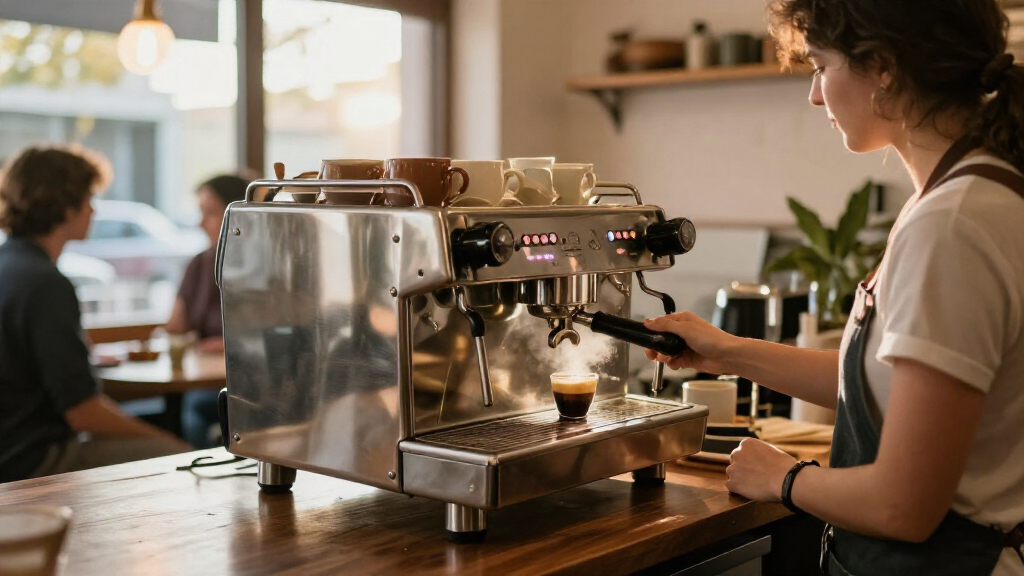
I ranked these machines by how well their stated design fits the promise of a commercial espresso machine, not by treating every product labeled commercial as interchangeable. My main questions were whether the machine has a credible setup for service work, how its boiler and group configuration relate to drink volume, and whether its electrical and physical requirements are practical for the intended location.
That method puts the Nuova Simonelli Appia Compact first for small commercial settings: its two groups, 7.5-liter boiler, soft infusion, and commercial components make a coherent café package, while its compact width addresses a real constraint. The 2-Group PID Touchscreen ranks second because its stated capacity and multi-boiler architecture point to heavier service, but the 154-pound body, 4,600-watt draw, and 32.2-inch width make it a more demanding installation. The Gevi and AMZCHEF rank below those machines because their capacities and 120-volt designs fit lighter-duty use better.
I also separated documented specifications from assumptions. The provided information does not identify service networks, water-line requirements, certifications, or warranty terms, so I do not treat those as established benefits. Buyers should verify them with the seller or manufacturer, especially for commercial installation. The ranking rewards a fit between workload, controls, footprint, and operating requirements; it is not a claim that one machine suits every business.
Factors to Consider When Choosing Rated Commercial Espresso Machine
I would start with the work the machine must do every day, then check whether the counter, utilities, and service plan can support it. Product labels alone do not establish commercial suitability; the specifications and the seller’s installation guidance matter more.Match capacity to the rush, not just the daily total
Think through the busiest hour: how many espresso drinks will be ordered close together, and how many staff members will use the machine? Two groups can let a barista prepare shots in parallel, which is why the Appia Compact and touchscreen machine suit café workflows better than the single-workflow Gevi and AMZCHEF. The touchscreen model states a daily capacity of 150–250 cups, but that figure does not replace a workload conversation with the seller. Ask about peak-hour performance, recovery, and the planned menu before committing.
Check power and installation before ordering
Voltage and wattage can determine whether a machine can be installed at all. The Appia listing specifies 220 volts, while the other three list 120 volts; the touchscreen model pairs a listed 110-volt supply with 4,600 watts, so I would verify that specification and required circuit directly before purchase. A commercial machine may also need professional plumbing, water treatment, drainage, and commissioning. Confirm requirements in writing rather than assuming a standard outlet or countertop will work.
Choose controls that match staff skill
Semi-automatic operation gives the barista responsibility for starting and managing extraction. That can suit a shop that values hands-on control, but it also calls for training and repeatable recipes. The touchscreen machine offers adjustable settings and scheduling features, while the Appia provides a more conventional café setup. The Gevi and AMZCHEF add accessible temperature controls for lighter use. I would give less weight to the number of settings than to whether staff can use them consistently during a rush.
Measure the full station and plan service
Compare machine dimensions with the usable counter, including room for portafilters, cups, milk pitchers, and staff movement. The Appia’s 55 cm width is a practical advantage over the touchscreen model’s 32.2-inch width, while the Gevi and AMZCHEF are compact but bring less café capacity. Check delivery access and the supporting equipment too. Before buying a machine for business use, ask about local technicians, parts availability, water-quality requirements, cleaning schedules, warranty coverage, and expected maintenance tasks.
Treat domestic machines as a different category
The Gevi and AMZCHEF may suit home use or a very light-duty station, but neither listing supplies the same commercial workflow details as the two-group machines. A 58mm portafilter or a pressure gauge does not by itself make a machine appropriate for café service. If customers depend on the equipment every day, prioritize workload fit and documented commercial support over an attractive control set. If the machine is mainly for home drinks or practice, the compact models can be more sensible than paying for installation and capacity you will not use.
Frequently Asked Questions
Which machine is the strongest fit for a small café?
I would start with the Nuova Simonelli Appia Compact. It combines two groups, a 7.5-liter boiler, and café-oriented components in a 55 cm width, making it a more balanced small-shop choice than the larger touchscreen model. Confirm the 220-volt installation requirements and service arrangements before ordering.
Which option has the highest stated daily capacity?
The 2-Group PID Touchscreen Commercial Espresso Machine is listed for 150–250 cups per day, the only explicit daily capacity figure provided for these four products. That figure should be checked with the seller against your menu and peak demand. Its size, weight, and 4,600-watt rating also mean that capacity comes with demanding installation needs.
Are the Gevi and AMZCHEF true commercial machines?
The supplied specifications make them better fits for home use or low-volume service than sustained café work. Both are 120-volt, single-workflow machines with much smaller capacities than the two-group models. A buyer considering either for a business should ask the manufacturer about commercial duty, service support, and warranty coverage before relying on it for daily customer orders.
Is a 58mm portafilter enough to choose a machine?
No. A 58mm portafilter is a useful workflow detail, but it does not indicate how well a machine handles repeated orders, steaming demand, or commercial maintenance. In this lineup, the Gevi and AMZCHEF both list 58mm portafilters, yet their capacities and operating profiles differ sharply from the Appia Compact and the touchscreen two-group machine.
What should I verify before buying a commercial espresso machine?
I would confirm voltage, circuit requirements, plumbing and drainage needs, water treatment, dimensions, delivery access, installation costs, and local technician availability. For the touchscreen model, verify the unusual pairing of its listed 110-volt supply and 4,600-watt rating directly with the seller. Also ask for maintenance and warranty terms, since those details are not included in the supplied product information.
Conclusion
My recommendation depends on the work ahead. For a small café or restaurant that needs two groups in a narrower footprint, I would choose the Nuova Simonelli Appia Compact, provided the 220-volt installation and service plan fit. For a higher-volume café with room, electrical capacity, and staff ready for a more configurable system, the 2-Group PID Touchscreen model is the capacity-led alternative. For a home barista or light-duty station, the Gevi offers a compact setup with temperature controls, while the AMZCHEF is a straightforward choice for someone who wants a pressure gauge and manual practice. I would not select either home-oriented machine as the primary espresso equipment for a busy café.
NFL season / tailgating Picks
team gear
As an affiliate, we earn on qualifying purchases.