A high-ticket commercial countertop bread oven should match your baking style, output, and available power—not just promise speed. My best overall pick is the Cadco XAF-193 for convection baking with humidity controls, while the Kratos double-deck stands out for separate baking chambers and the VEVOR 4.24-cu.-ft. oven for rack capacity. The main tradeoff is between flexible, batch-based convection ovens and conveyor models designed for steady, repeatable throughput. Electrical requirements also range from standard 120V options to high-draw 208–240V and three-phase units. Read on for the full breakdown and buying advice to help match an oven to your operation.

Get kitchen staples and gadgets delivered free with Prime
- Fast, free delivery on millions of items
- Prime Video, Amazon Music and more included
- Member-only deals all year
Key Takeaways
- Convection ovens suit varied bread menus: the Cadco XAF-193 combines manual controls and humidity, while the VEVOR offers four racks and 360-degree hot-air circulation.
- Deck ovens offer chamber separation, not conveyor speed: the Kratos and Krollen double-deck models let operators manage separate baking spaces, but take a different approach to continuous production.
- Conveyor models are specialized for repeatable flow: belt width, speed adjustment, and electrical supply matter more than rack count when products move through continuously.
- Power availability can rule out a shortlist: several larger ovens call for 208–240V, while the 18-inch conveyor listing specifies 220V three-phase power and 9kW.
- Compact 120V units trade capacity for easier placement: the KWS CO-3 and 10.5-inch conveyor model may suit limited-volume work, but they are not direct substitutes for high-output equipment.




| high ticket commercial bread oven countertop | Dimensions | Temperature range | Voltage | Capacity |
|---|---|---|---|---|
| Cadco XAF-193 Heavy-Duty Count | 31.5 x 23 x 32 inches | 175–500°F | 208–240V | 3.85 cubic feet |
| Kratos Commercial Double-Deck | 23.31 x 27.95 x 26.38 inches | 150–840°F | 240V | — |
| VEVOR Commercial Convection Ov | 29.65 x 32.87 x 22.24 inches | 86–572°F | 208–240V | 120 liters (4.24 cu. ft.) |
| 10.5-Inch Commercial Conveyor | 36.5 x 17 x 19.3 inches | — | 120V | — |
| TECHTONGDA Countertop Conveyor | 23.2 x 58.7 x 14.2 inches | — | 220V | 4,155 cubic inches |
| Omcan 11387 Conveyor Commercia | 41 x 18.5 x 15.7 inches | 140–500°F (60–260°C) | — | 16 14-inch, 19 12-inch, or 25 9-inch pizzas per hour |
| Commercial Conveyor Pizza Oven | 76.7 x 40.1 x 18.9 inches | 32–572°F (0–300°C) | — | — |
| Krollen Industrial Double Deck | 28 x 23.25 x 26.38 inches | 150–840°F | 240V | — |
| KWS CO-3 1600W Commercial Coun | 23.5 x 23.5 x 22.5 inches | 0–572°F | 120V | 2 cu. ft. |
| Omcan 11387 14-Inch Wide Conve | 41 x 18.5 x 15.7 inches | 140–500°F | 240V / 60Hz / 1-phase | 19 12-inch or 25 9-inch pizzas per hour |
More Details on Our Top Picks
Cadco XAF-193 Heavy-Duty Countertop Convection Oven with Manual Controls and Humidity, Stainless Steel, NSF, 208-240V
The Cadco XAF-193 is my strongest match here for bakeries that need a multi-rack convection oven rather than a pizza-focused conveyor. Its four adjustable shelves, 175–500°F range, and humidity options give operators more control over crust and bake conditions than the Kratos double-deck oven, whose listed strengths center on high-temperature pizza and bakery work. At 3.85 cubic feet, it can handle several trays at once, while NSF certification and stainless-steel construction suit commercial settings. The tradeoff is a substantial 120-pound body and a 5,600W draw, so this needs a suitable counter and electrical supply. Manual controls also demand more operator attention than a straightforward preset-oriented workflow. I’d choose it for varied bread production, not for a small counter or a plug-in setup.
Pros:- Four adjustable shelves support simultaneous tray baking.
- Humidity options provide added control over bread-baking conditions.
- Manual temperature range of 175–500°F suits a range of baking and roasting tasks.
- NSF certification and stainless-steel construction fit commercial kitchen use.
Cons:- At 120 pounds, it is difficult to reposition and needs a sturdy installation surface.
- Its 5,600W draw requires a suitable 208–240V electrical setup.
- Manual temperature and humidity adjustments may take operator training.
Best for: Small commercial bakeries and restaurant kitchens that bake several tray-based bread products and can provide 208–240V power.
Not ideal for: Home bakers or compact cafés without heavy-duty electrical service, a sturdy counter, or room for a 31.5-inch-wide oven.
- Capacity:3.85 cubic feet
- Shelves:4 adjustable shelves
- Temperature range:175–500°F
- Voltage:208–240V
- Wattage:5,600W
- Dimensions:31.5 x 23 x 32 inches
- Weight:120 lbs
- Certification:NSF
Our verdict“Choose the Cadco for flexible, humidity-assisted, multi-tray bread baking if your kitchen can support its size and electrical demand.”
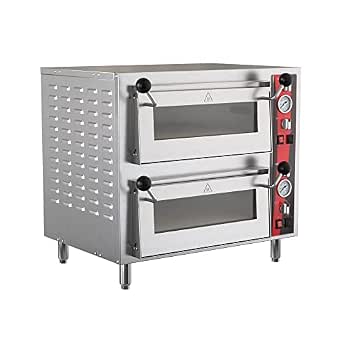
Kratos Commercial Double-Deck Countertop Electric Pizza/Bakery Oven
The Kratos stands apart from the Cadco XAF-193 by favoring two deck-style chambers and a much higher maximum temperature over humidity-assisted convection. Its 150–840°F range can suit shops that bake bread alongside pizza or other products needing intense heat, and the two shelves offer separate deck positions in a countertop format. The simple dial controls keep operation accessible for staff who do not need the Cadco’s more involved manual humidity adjustments. Still, the provided specifications do not clarify chamber independence, and its 3,200W rating is lower than the Cadco’s 5,600W, so buyers should match expected throughput and electrical setup rather than assume the double-deck layout guarantees faster production. I’d shortlist it for mixed pizza-and-bakery service, but bread-focused operators should verify capacity and chamber details before choosing.
Pros:- Temperature range reaching 840°F suits high-heat baking alongside bread production.
- Two-deck layout offers more baking positions than a single-level compact oven.
- Dial controls are straightforward for staff to operate.
- Stainless-steel construction and cool-to-touch handles support commercial service.
Cons:- Humidity control is not listed, limiting control over bread crust conditions.
- The specifications do not establish whether the two chambers operate independently.
- At 3,200W, it has less listed power than the Cadco XAF-193.
Best for: Pizzerias and small bakery counters that want a high-temperature countertop oven with two deck levels for mixed baking tasks.
Not ideal for: Bread producers who need documented humidity control, multiple tray capacity, or clear confirmation of independent chamber operation.
- Model:29M-063
- Number of shelves:2
- Temperature range:150–840°F
- Power:3,200W
- Voltage:240V
- Dimensions:23.31 x 27.95 x 26.38 inches
- Material:Stainless steel
- Controls:Knob
Our verdict“Pick the Kratos for a compact, high-heat pizza-and-bakery station, but verify chamber capacity if bread is the main output.”
VEVOR Commercial Convection Oven, 4.24 cu.ft Countertop Electric Oven with 4 Racks, 360° Hot Air Circulation, 208-240V, 5000W
For kitchens prioritizing rack capacity, the VEVOR offers the largest stated oven volume in this group at 120 liters, with four racks and dual-fan circulation. That makes it a more natural fit for batch baking than the Kratos double-deck oven, which is aimed at higher-heat deck-style work, and its 572°F ceiling exceeds the Cadco XAF-193’s 500°F limit. The 86–572°F range also gives operators room for lower-temperature tasks as well as bread. The cost of that capacity is physical: at 144.2 pounds and nearly 33 inches wide, it calls for substantial counter space and planned placement. Its 5,000W draw also demands commercial electrical service. I’d favor it when several racks matter more than a compact footprint or humidity control.
Pros:- 120-liter capacity and four racks support sizeable batch production.
- Dual convection fans are specified for circulating hot air across the oven.
- Temperature range extends from 86°F to 572°F.
- Stainless-steel construction is suited to commercial kitchen use.
Cons:- Its 144.2-pound weight makes installation and relocation difficult.
- Nearly 33 inches of width and 29.65 inches of depth require ample counter space.
- The 5,000W rating requires a suitable high-power electrical connection.
Best for: Commercial bakeries and food-service kitchens producing multiple trays of bread or baked goods per batch with 208–240V service.
Not ideal for: Small cafés, mobile food operators, or bread makers who need a lighter oven or listed humidity controls.
- Capacity:120 liters (4.24 cu. ft.)
- Racks:4
- Temperature range:86–572°F
- Voltage:208–240V
- Power:5,000W
- Dimensions:29.65 x 32.87 x 22.24 inches
- Weight:144.2 lbs
- Material:Stainless steel
Our verdict“Choose the VEVOR when four-rack capacity and a broad temperature range matter more than a compact footprint or humidity features.”
10.5-Inch Commercial Conveyor Pizza Oven, 1700W 120V Countertop Electric Oven with Belt for Fast Baking
This 10.5-inch conveyor is the most accessible electrical fit in the lineup, running on 120V and 1,700W rather than the 208–240V service required by the Cadco and VEVOR convection ovens. Its moving belt can keep small items flowing through a repeatable bake path, unlike those rack ovens, which are better suited to loading trays in batches. For bread, that format makes more sense for small rolls or compact baked goods than full loaves: the 10.5-inch belt is a real limit, and the listing gives little detail about temperature adjustment. At 36.5 inches deep, it also takes up considerable counter space despite its narrower belt. I’d pick it for a narrow, consistent product range, not for flexible bakery production or large-batch bread.
Pros:- 120V connection is less demanding than the high-voltage setup required by the Cadco XAF-193.
- Conveyor operation supports a steady flow of small products.
- Stainless-steel construction is suited to commercial use.
- Removable components are described as easy to clean.
Cons:- The 10.5-inch belt restricts product size and limits usefulness for full-size bread loaves.
- Temperature-control details are not provided.
- Its 36.5-inch depth takes substantial counter space for a narrow-belt oven.
Best for: Small food-service operations baking compact rolls or other small items continuously where 120V power is a practical requirement.
Not ideal for: Bread shops producing full-size loaves or varied tray batches, and operators who need clearly specified temperature controls.
- Belt size:10.5 inches
- Voltage:120V
- Wattage:1,700W
- Control type:Knob
- Dimensions:36.5 x 17 x 19.3 inches
- Material:Stainless steel
- Shelves:1
Our verdict“Choose this conveyor for compact products and a 120V kitchen setup, not for versatile or high-volume loaf baking.”
TECHTONGDA Countertop Conveyor Pizza Oven 6KW Commercial Chain Type Baking Electric Oven with 12″ Belt Suitable for Pizza, Bread, Biscuits, Cakes
The TECHTONGDA is the conveyor choice for buyers who need a wider belt and more heating power than the 10.5-inch, 1,700W model above. Its 12-inch belt and 6kW output are specified for continuous baking, with dual-zone temperature control giving operators more adjustment than the smaller conveyor’s limited control information. That makes it a better fit for a focused production line of pizzas, biscuits, or similarly sized products than for tray-based bread runs, where the four-rack Cadco XAF-193 or VEVOR offers more flexible loading. The tradeoff is a large, nearly 59-inch-wide body, a 165-pound weight, and 220V power. I’d treat it as a dedicated station for repeat products, not a compact countertop oven or an all-purpose bakery workhorse.
Pros:- 12-inch belt accommodates larger items than the 10.5-inch conveyor in this roundup.
- 6kW heating system is specified for rapid, continuous baking.
- Dual-zone temperature control allows separate adjustment across baking zones.
- Multi-function control panel supports varied conveyor operation.
Cons:- At 58.7 inches wide, it requires an unusually long counter or dedicated station.
- Its 165-pound weight makes moving or repositioning it difficult.
- 220V power and conveyor-style operation may not suit smaller or tray-focused bakeries.
Best for: Commercial kitchens running repeated batches of 12-inch-or-smaller products and able to dedicate space and 220V power to a conveyor line.
Not ideal for: Small bakeries with limited counter space, operators needing multi-rack loaf capacity, or kitchens without 220V service.
- Belt size:12 inches
- Wattage:6kW
- Voltage:220V
- Dimensions:23.2 x 58.7 x 14.2 inches
- Weight:165 lbs
- Material:Stainless steel
- Capacity:4,155 cubic inches
- Temperature control:Dual-zone
Our verdict“Choose the TECHTONGDA for a dedicated, continuous-baking station with a wider belt, provided you can accommodate its footprint and power needs.”
Omcan 11387 Conveyor Commercial Restaurant Countertop Pizza Baking Oven TS7000
The Omcan TS7000 is the more practical fit for a compact foodservice operation that wants conveyor consistency without moving up to the 9 kW, 268.9-pound 18-inch conveyor model. Its ventless design and infrared heat suit counter-service kitchens with limited room for separate ventilation, while the belt handles a stated 16 14-inch pizzas per hour or 25 9-inch pizzas per hour. For bread, it is better viewed as a reheating and small-batch baking tool than a dedicated artisan bread oven. The 140–500°F range covers a useful spread of tasks, but the manufacturer description specifically warns against frozen pizza, narrowing its flexibility for some menus. At 61 pounds, it is still a substantial countertop appliance, and its 14-inch opening limits what can pass through. Compared with the Krollen double-deck oven, it favors continuous throughput over separate batches and independent chamber settings.
Pros:- Ventless design suits kitchens with limited ventilation options
- Conveyor output is specified for several pizza sizes
- Infrared heating and adjustable temperature support varied fresh-food tasks
- Stainless steel body is suited to regular foodservice use
Cons:- Not recommended for frozen pizzas
- The 14-inch-wide opening limits product size
- At 61 pounds, it is not easy to reposition frequently
Best for: Cafes and small foodservice kitchens reheating bread or baking fresh, non-frozen pizza in a steady conveyor workflow.
Not ideal for: Operators whose menu relies on frozen pizzas, oversized loaves, or batch baking in separate chambers.
- Power:3.6 kW
- Electrical:240V / 60Hz / 1-phase
- Temperature range:140–500°F (60–260°C)
- Capacity:16 14-inch, 19 12-inch, or 25 9-inch pizzas per hour
- Dimensions:41 x 18.5 x 15.7 inches
- Opening:3.25 inches high x 14 inches wide
- Material:Stainless steel
- Weight:61 pounds
Our verdict“Choose the TS7000 if you need compact conveyor service for fresh pizza and bread reheating, but skip it if frozen products are central to your menu.”
Commercial Conveyor Pizza Oven, 18-inch, 220V, 3-Phase, 9kW, Temperature 32-572°F
This 18-inch conveyor oven is the throughput-led pick in this group, with a larger stated pizza capacity than the 14-inch Omcan TS7000 and a temperature ceiling of 572°F. Hot-air circulation and a reversible chain are intended to support even cooking and flexible line layout; the stated 3–12 minute time range also gives operators a defined starting point for product pacing. Its broad temperature range makes it more adaptable to bread and other baked goods than the Omcan, whose description rules out frozen pizza. The tradeoff is a major jump in installation demands: this model needs 220V three-phase power, draws 9 kW, and measures 76.7 inches long. At nearly 269 pounds, it is closer to fixed production equipment than a casually movable countertop oven. I would reserve it for a bakery or pizzeria with the utilities, counter run, and volume to justify that footprint.
Pros:- 18-inch maximum pizza diameter accommodates larger products
- Hot-air circulation is designed for more even baking
- Reversible conveyor adds flexibility to production-line placement
- Wide 32–572°F range supports more than pizza alone
Cons:- Requires 220V three-phase electrical service
- 9 kW draw brings substantial power demand
- Large footprint and 268.9-pound weight make installation and relocation difficult
Best for: Established pizzerias and bakeries with 220V three-phase service, a long counter, and sustained conveyor-baking demand.
Not ideal for: Small cafes or startup kitchens with standard single-phase outlets, limited counter length, or modest daily output.
- Voltage and phase:AC 220V, 3-phase
- Power:9 kW
- Maximum pizza diameter:18 inches
- Temperature range:32–572°F (0–300°C)
- Time range:3–12 minutes
- Heating chamber:27.5 x 19.6 inches
- Dimensions:76.7 x 40.1 x 18.9 inches
- Net weight:268.9 pounds
Our verdict“Pick this model for a high-volume operation with suitable three-phase power and room for a long conveyor, not for a small countertop setup.”
Krollen Industrial Double Deck Countertop Pizza/Bakery Oven with Two Independent Chambers – 3200W, 240V
The Krollen’s key distinction is two independently controlled chambers, not conveyor speed. That layout lets a bakery run different products or temperatures at once, a more useful workflow for mixed bread and pizza batches than the continuous belt of the Omcan TS7000. Each chamber is listed at 18 x 18 x 4 inches, and the cordierite deck is the feature most directly suited to crust development. Its listed 150–840°F range is unusually broad for this set, though the supplied data does not detail control precision or recovery between batches. At 3,200W, it also offers a different electrical profile from the 9 kW, three-phase conveyor oven, but still requires 240V. The cost of this batch-oriented approach is a 28 x 23.25-inch counter footprint and manual knob controls; buyers wanting a fast, continuous stream should favor a conveyor instead.
Pros:- Two chambers operate independently for different products or temperatures
- 18 x 18-inch chamber dimensions accommodate substantial individual items
- Cordierite deck is suited to crust-focused baking
- Listed 150–840°F range gives broad temperature coverage
Cons:- 28 x 23.25-inch footprint takes significant counter space
- 240V requirement may call for dedicated electrical planning
- Available information does not establish digital controls or advanced programming
Best for: Small bakeries and cafes that bake different breads or pizzas in batches and can use two temperature-separated chambers.
Not ideal for: Busy lines needing continuous belt-fed output, or kitchens without 240V service and ample counter depth.
- Wattage:3,200W
- Voltage:240V
- Dimensions:28 x 23.25 x 26.38 inches
- Baking chamber size:18 x 18 x 4 inches per chamber
- Temperature range:150–840°F
- Number of chambers:2
- Deck material:Cordierite
- Control type:Knob
Our verdict“Choose the Krollen for flexible, crust-focused batches across two chambers; choose a conveyor model when continuous throughput matters more.”
KWS CO-3 1600W Commercial Countertop Convection Oven, 2 Cu. Ft. – 120V, 4-Tier Toaster with Front Glass Door
The KWS CO-3 is the most accessible electrical fit for kitchens that need a commercial-style oven but lack 240V service: it runs on 120V and provides a 2-cubic-foot cavity with four shelves. That makes it a better match for multiple trays of rolls, pastries, or reheating tasks than either Omcan conveyor, which moves products through a narrower belt opening. Its temperature setting reaches 572°F, while the glass door helps staff check food without opening the cavity. The tradeoff is power: at 1,600W, it is not the high-throughput choice for a demanding bread line, and the supplied details do not specify baking capacity per hour or humidity control. Its 23.5-inch width and depth also take real counter space. Compared with the Krollen double-deck oven, it offers shelf-based batch flexibility, but not separate chambers or a cordierite deck.
Pros:- 120V connection suits kitchens without 240V service
- Four shelves and 2 cu. ft. capacity support multi-tray batches
- Temperature range reaches 572°F
- Glass door allows food monitoring without opening the oven
Cons:- 1,600W output may be limiting for sustained, high-volume baking
- Large countertop footprint can crowd a small prep area
- No supplied throughput or humidity-control details for planning bread production
Best for: Cafes, delis, and small bakeries needing a four-shelf countertop oven for tray-based bread and pastry work on 120V.
Not ideal for: High-volume bakeries seeking fast continuous output, or operators who need independent baking chambers or a stone-style deck.
- Power:1,600W
- Voltage:120V
- Capacity:2 cu. ft.
- Shelves:4
- Temperature range:0–572°F
- Dimensions:23.5 x 23.5 x 22.5 inches
- Material:Stainless steel
- Door:Cool-touch dual-pane glass
Our verdict“Choose the KWS for tray-based bread work on a standard outlet, but select a conveyor or double-deck model for greater production pace or crust-focused baking.”
Omcan 11387 14-Inch Wide Conveyor Belt Adjustable Heat and Speed Stainless Steel Infrared Baking Oven
This Omcan TS-7000 listing suits operators who value adjustable heat and conveyor speed for repeatable service, with removable trays and drip pans called out for cleanup. Its 14-inch belt and stated pace of 19 12-inch or 25 9-inch pizzas per hour place it in the same compact conveyor class as the Omcan TS7000. The listing gives less detail on 14-inch-pizza capacity than the TS7000 product data, but adds the explicit speed-control and cleanup points. That makes it a reasonable fit for cafes baking fresh items and reheating bread in a steady flow, rather than kitchens relying on frozen pizza. It still needs 240V single-phase power, occupies a 41-inch length, and weighs 61 pounds, so “countertop” does not mean easy to move. Against the KWS CO-3, it prioritizes belt-fed service over multi-shelf batch baking.
Pros:- Adjustable heat and conveyor speed support repeatable cooking workflows
- 14-inch belt suits a range of smaller foodservice items
- Removable trays and drip pans simplify routine cleanup
- Stainless steel construction is suited to commercial use
Cons:- Requires 240V / 60Hz single-phase power
- 41-inch length and 61-pound weight make it difficult to relocate
- Product description does not recommend frozen pizzas
Best for: Cafes and food counters that need adjustable belt pacing for fresh pizza, bread, and similar items, with 240V service available.
Not ideal for: Small operations limited to 120V, kitchens that depend on frozen pizza, or buyers needing a compact oven to move between workstations.
- Brand and model:Omcan TS-7000, 11387
- Power:3.6 kW
- Voltage:240V / 60Hz / 1-phase
- Temperature range:140–500°F
- Conveyor width:14 inches
- Capacity:19 12-inch or 25 9-inch pizzas per hour
- Dimensions:41 x 18.5 x 15.7 inches
- Weight:61 pounds
- Warranty:1 year parts and labor
Our verdict“Choose this Omcan when adjustable conveyor pacing and easier cleanup matter more than multi-shelf capacity or 120V compatibility.”

How We Picked
I ranked these options for commercial countertop bread baking by looking first at baking format and likely workload: convection for flexible batches, deck ovens for separate chamber baking, and conveyors for ongoing, repeatable throughput. I then weighed usable capacity, controls that affect consistency, stated power requirements, construction details, and how well the listed design fits bread rather than only pizza. A larger oven did not automatically rank higher; equipment that asks for more power or a narrower production style needs a clear operational reason.
The Cadco XAF-193 ranks first because humidity control and convection make it the most adaptable choice in this lineup for varied baked goods. The VEVOR and Kratos follow for rack capacity and double-deck flexibility, while conveyor models rank better for operations built around a steady stream of similar items. Compact 120V choices sit lower for high-volume use, though they may be more practical for smaller work areas or limited electrical service. I treated the listed specifications as the basis for comparison, not as a guarantee of performance with every bread recipe.
Factors to Consider When Choosing High Ticket Commercial Bread Oven Countertop
Choosing a countertop oven for commercial bread production starts with the way orders move through your kitchen. Match the oven to your recipes, daily volume, power supply, and available counter space before comparing headline wattage or chamber size. These broader checks can help avoid paying for capacity your workflow cannot use—or buying a small unit that becomes a bottleneck.
Match the Baking Format to Your Bread
Convection, deck, and conveyor ovens solve different production problems. Convection circulates heated air and can support varied batches, while deck-style chambers give staff separate spaces for different products or bake settings. A conveyor is designed to move similar items through at a consistent pace, which can suit repeatable production but may be less flexible for varied loaf sizes and recipes. Think about whether your bread needs steam, a particular crust, or a stable resting space as it bakes. Do not assume a pizza-focused oven will handle every bread format equally well; verify chamber dimensions and usable belt or rack area against the products you actually sell. A format that fits the recipe often matters more than a higher wattage figure.
Calculate Capacity by Batch and Workflow
Capacity is more than the number of racks or the belt width. Consider how many loaves fit with room for heat to circulate, how long each batch occupies the oven, and whether staff can load and unload without interrupting other work. A four-rack oven may offer useful batch capacity, but it still depends on tray dimensions and spacing. A conveyor can keep items moving, yet a narrow belt may limit the size or quantity of each product. Map your busiest service period and identify the actual bottleneck: oven time, proofing, shaping, or labor. Buying a larger unit will not increase output if another step already sets the pace.
Check Electrical Service Before Ordering
Electrical compatibility can determine which ovens are viable at all. This lineup includes 120V models alongside units rated for 208–240V, 220V, and, for one conveyor, three-phase power. Confirm voltage, phase, amperage, plug type, and circuit requirements with the product documentation and a qualified electrician before purchase. A high-wattage oven may need a dedicated circuit or facility upgrades, adding cost and installation time beyond the appliance itself. Do not rely on a wall outlet appearing compatible; matching voltage alone does not confirm that the circuit can support the load. If your site has limited service, a smaller oven that fits the existing electrical setup may be the practical choice.
Treat Steam and Humidity as Recipe Tools
Humidity controls are useful only when your menu benefits from them. Some breads need moisture early in baking for crust development, while other products may call for a drier environment. A control labeled for humidity does not by itself tell you how much steam the oven can produce or how it behaves across a full bake cycle, so check the operating details. If you bake a narrow range of products, a simpler oven may be easier for staff to operate and maintain. For a mixed menu, adjustable controls can offer flexibility, but they also add settings that require training and repeatable procedures. Test recipes in small batches before committing production to a new oven.
Plan for Counter Space, Clearance, and Cleaning
Countertop placement still requires a full installation plan. Measure the oven footprint, door swing, loading area, and room for safe ventilation or clearance as specified by the manufacturer. Conveyor units also need space for loading and collecting baked items at the belt ends, while deck ovens require practical access to each chamber. Stainless-steel construction can support routine cleaning, but removable parts, crumb access, and the location of heating elements affect how much labor maintenance takes. Ask who will clean the oven and how often before choosing a design with hard-to-reach areas. A model that fits the counter but blocks prep space can slow down the whole line.
Pay More for a Proven Production Need
Spend on features that solve a recurring constraint. Separate chambers, humidity control, broader capacity, or a conveyor can justify a more demanding installation when they match daily volume and product consistency needs. For occasional baking or a smaller menu, paying for a high-output three-phase oven may add complexity without improving service. Include the cost of electrical work, installation, staff training, cleaning, and replacement parts in the ownership decision—not only the purchase of the oven. Ask the supplier about warranty coverage, service access, and compatible trays or belts before choosing a less familiar format. A clear production target helps distinguish useful capacity from equipment that is simply larger or more specialized.
Frequently Asked Questions
Which oven style is the better fit for artisan loaves: convection, deck, or conveyor?
The right style depends on the crust, loaf shape, and production rhythm you need. Convection is a flexible choice for mixed batches, while deck ovens provide separate chambers that can help operators manage different products independently. Conveyor ovens are strongest when items are similar and a continuous flow matters more than batch flexibility. For crust-sensitive breads, confirm whether the oven can provide the moisture and heat profile your recipes require rather than relying on its category label. If you are unsure, compare test bakes using your own dough and trays before selecting a production model.
Can I run a 208–240V countertop oven from a standard 120V outlet?
No—do not assume a plug adapter can make an incompatible oven safe to operate. Voltage, phase, amperage, and circuit capacity all need to match the unit’s specifications. Some models in this roundup are listed for 120V, while several larger options require higher-voltage service and one conveyor specifies three-phase power. Have a qualified electrician check your site and confirm what installation the chosen oven requires. If electrical upgrades are not practical, shortlist models that match your existing service instead of planning around an improvised connection.
Is a conveyor oven a good choice for a bakery that makes several bread types?
A conveyor can work well when products have similar bake requirements and can share a consistent belt path. Frequent changes in loaf size, bake time, or temperature may make a conveyor less flexible than a batch-style convection or deck oven. Belt width also limits how products can be arranged and what sizes can pass through. Consider whether staff can adjust belt speed and heat for your recipes, and check how quickly those settings can be changed between orders. For a broad menu, a conveyor may be best as a dedicated station rather than the bakery’s only oven.
How should I compare rack capacity with conveyor belt width?
Compare the usable production area against the way you bake, not the headline number alone. Racks allow multiple trays to bake as a batch, but tray size, clearance, and airflow determine how much product fits in practice. A belt supports continuous movement, though its width and speed set the size and pace of each run. Estimate output over a complete service period, including loading, baking, unloading, and any changeover time. That calculation gives a more useful comparison than treating four racks and a wide belt as equivalent measures of capacity.
What should I verify before buying a high-capacity countertop oven?
Verify the installation requirements and service plan alongside the oven’s baking capacity. Confirm exact electrical needs, physical dimensions, ventilation clearances, and the space required for loading and unloading. Ask what trays, racks, or belts are included and which replacements fit the model. Check the warranty, access to authorized service, cleaning instructions, and availability of parts for the components most likely to need attention. Finally, match the oven’s rated workload to your expected daily use; a large chamber is only an advantage if your kitchen can power, staff, and maintain it.
Conclusion
For the broadest mix of commercial bread tasks, I recommend the Cadco XAF-193 as best overall, especially for buyers who value convection and humidity controls. The VEVOR 4.24-cu.-ft. model is my best value for rack-based capacity when its higher-voltage requirements suit the site, while the Kratos double-deck is the best premium-style choice for operators who want separate chambers. Beginners with modest output and compatible 120V service should start by considering the KWS CO-3, while keeping its compact capacity in mind. For a specific need—steady movement of similar products—the conveyor models are the better fit, but buyers should verify belt dimensions and electrical service before choosing one. Match the oven to your recipes and facility first; then narrow the shortlist by the production format your staff can use consistently.