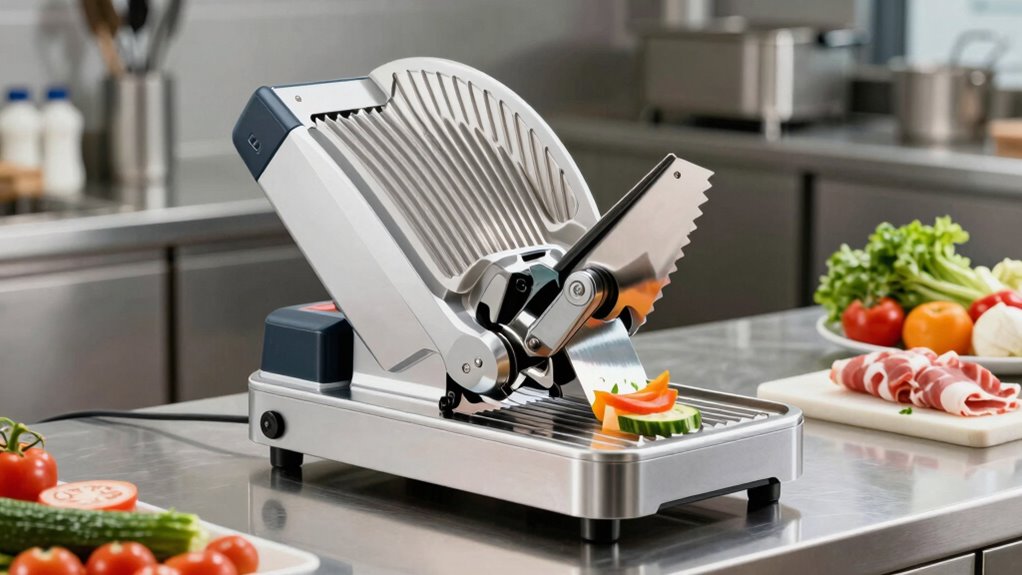
For frequent meal prep and hosting, the Vollrath 40952 Heavy-Duty 12-Inch Electric Cheese and Meat Slicer is my best overall pick for buyers who want a larger blade and a heavy-duty electric format. The Globe C10 Chefmate is a strong manual choice for hands-on control, while the KWS MS-14A suits buyers who prioritize automatic slicing and higher-volume work. The main tradeoffs are manual control versus powered throughput, compact 10-inch blades versus larger cutting capacity, and convenience versus cleaning and counter space. A higher-powered machine is not automatically the best fit for occasional hosting, particularly when setup and maintenance are part of every use. Read on for the full breakdown and guidance on choosing the right slicer for your kitchen’s workload.

Get kitchen staples and gadgets delivered free with Prime
- Fast, free delivery on millions of items
- Prime Video, Amazon Music and more included
- Member-only deals all year
Key Takeaways
- The lineup splits by workload: the Globe C10 is manual, while the KWS MS-14A and VEVOR are automatic options built around powered operation.
- A larger blade may help with bigger cuts: the Vollrath’s 12-inch blade sets it apart from the 10-inch Globe, KWS MS-10ES and Sirman models.
- Motor wattage alone does not settle the choice: the 850W Newhai and 2550W KWS MS-14A warrant closer checks on intended use, feed method, and operating instructions before purchase.
- Hosting favors control as well as output: a manual slicer can suit smaller batches and hands-on thickness adjustment, while an automatic machine makes more sense when repeated slicing is the priority.
- Match the machine to your foods: the Vollrath is specifically described for cheese and meat, while the Sirman’s 10-inch blade, built-in sharpener, and hand guard make its stated features especially relevant to routine slicing tasks.


| high ticket commercial food slicer for meal prep and hosting | Motor power |
|---|---|
| Globe C10 Chefmate Manual Slic | 1/4 HP |
| KWS KitchenWare Station MS-10E | 320W |
| Sirman Smart 250-10” Entry Sl | 0.25 HP |
| Newhai 850W Commercial Meat Cu | — |
| Vollrath 40952 Heavy-Duty 12-I | 1/2 HP |
| KWS KitchenWare Station MS-14A | — |
| VEVOR Fully Automatic Meat Sli | — |
More Details on Our Top Picks
Globe C10 Chefmate Manual Slicer, 10″ Knife, 0-9/16″ Adjustable, NSF & ETL
The Globe C10 Chefmate suits households and small food operations that want a commercial-style slicer without stepping up to a heavier-duty motor. Its 10-inch blade and thickness adjustment up to 9/16 inch cover deli meats, cheeses, and a range of hosting platters, while the built-in sharpener helps keep routine prep consistent. Compared with the KWS MS-10ES, it has a lower-powered 1/4 HP motor, so I’d favor the KWS for frequent, faster batches. The Globe’s 33-pound anodized aluminum body and NSF and ETL listings make it a considered choice for a stable prep station, but not a grab-and-store appliance. Manual feeding also asks more effort from the operator, and its light-commercial design is a poor match for sustained high-volume slicing.
Pros:- Thickness adjusts from 0 to 9/16 inch for thin sandwich cuts and thicker serving slices.
- Built-in dual-action sharpener supports regular blade upkeep.
- Anodized aluminum construction is suited to a lasting prep station.
- NSF and ETL standards make it a stronger fit for foodservice settings than an uncertified home-oriented model.
Cons:- The 1/4 HP motor and light-commercial positioning limit its fit for sustained heavy workloads.
- Manual operation requires more operator effort than the electric KWS MS-10ES.
- At 33 pounds, it is not especially convenient to move or store.
Best for: Home hosts and small foodservice operators who slice moderate batches and can leave a 33-pound machine set up on a dedicated counter.
Not ideal for: Delis or caterers slicing continuously, and buyers who need low-effort powered throughput or an easy-to-store appliance.
- Blade diameter:10 inches
- Slice thickness:0 to 9/16 inch
- Motor power:1/4 HP
- Material:Anodized aluminum
- Voltage:115V, 60Hz, single phase
- Weight:33 pounds
- Dimensions:17.25 x 15 x 19 inches
- Features:Removable gravity-feed chute, top-mounted sharpener, slice deflector, knife cover, belt-driven system
Our verdict“Choose the Globe C10 for measured, moderate meal-prep batches and skip it if your hosting or service volume demands faster continuous slicing.”
KWS KitchenWare Station MS-10ES 320W Electric Slicer with Extended Back Space
The KWS MS-10ES is the more capable choice for cooks who regularly prepare trays of sliced meat, cheese, fruit, or vegetables for a crowd. Its 320W, 0.4 HP motor gives it a clear power advantage over the Globe C10’s 1/4 HP motor, while the 10-inch stainless steel blade and adjustment to 0.55 inch suit a broad range of everyday serving cuts. The extended back space is intended to support a busier workflow, and quiet operation may be welcome in a home kitchen as well as a small commercial one. A built-in dual whetstone sharpener reduces the need for separate sharpening tools. The tradeoff is its bulky footprint: compared with the compact-use positioning of the Sirman Smart 250, this KWS asks for more permanent counter room.
Pros:- 320W pure copper motor provides more power than the Globe C10’s 1/4 HP motor.
- Thickness adjusts from 0 to 0.55 inch for a range of meal-prep and serving cuts.
- Built-in dual whetstone sharpener keeps blade maintenance on the machine.
- ETL and NSF certifications and quiet operation suit mixed home and foodservice use.
Cons:- Bulky footprint calls for ample, preferably dedicated counter space.
- Its 10-inch blade and 0.55-inch maximum thickness may not suit buyers seeking the larger blade and thicker cuts of the Vollrath 40952.
Best for: Frequent hosts, meal-prep cooks, and small foodservice teams that want powered slicing for varied ingredients and have room to keep the machine set up.
Not ideal for: Small kitchens with limited counter space, or buyers who slice only occasional small portions and do not need a higher-powered electric model.
- Blade:10-inch 304 stainless steel
- Motor power:320W
- Motor type:Pure copper
- Horsepower:0.4 HP
- Thickness range:0 to 0.55 inch (0 to 14 mm)
- Tray dimensions:7 x 7.5 x 5.5 inches
- Certifications:ETL and NSF
- Warranty:1-year factory limited warranty
Our verdict“Pick the KWS MS-10ES if you want more powered capacity than a light-duty slicer for regular batch prep and can spare the counter space.”
Sirman Smart 250-10” Entry Slicer – 10-Inch Chromium-Plated Blade, 0.25 Hp Air-Cooled Motor, Die-Cast Aluminum, Built-In Sharpener, Safety Hand Guard
The Sirman Smart 250 makes sense for buyers who put operator protection and cleanup ahead of extra motor power. Its safety hand guard and cover add useful safeguards during repetitive slicing, while the die-cast aluminum body and fan-cooled 0.25 HP motor suit steady small-batch prep. Easy disassembly for cleaning is particularly helpful when a slicer moves between meats and cheeses for a hosting spread. Compared with the KWS MS-10ES, the Sirman has a lower-powered motor, so I’d favor the KWS for faster, more frequent batches. Its 10-inch blade also gives up the broader capacity of the Vollrath 40952’s 12-inch blade. At 37 pounds and 20 x 24 x 16 inches, it still needs a dedicated space, and manual feeding means no automatic slicing convenience.
Pros:- Safety hand guard and cover add protection during manual slicing.
- Fan-cooled 0.25 HP motor is designed for extended operation.
- Die-cast aluminum construction supports regular food-prep use.
- Easy disassembly helps with cleaning between different foods.
Cons:- Lower motor power than the KWS MS-10ES makes it less suited to rapid batch work.
- The 10-inch blade has less capacity than the Vollrath 40952’s 12-inch blade.
- At 37 pounds with a 20 x 24 inch footprint, it is cumbersome for frequent storage and setup.
Best for: Small caterers and safety-minded home hosts who want a commercial-style slicer with a hand guard and removable parts for cleaning.
Not ideal for: High-volume kitchens needing faster powered throughput, buyers processing larger cuts, or anyone who needs a compact machine to move after each use.
- Blade diameter:10 inches
- Blade material:Chromium-plated steel
- Motor power:0.25 HP
- Construction:Die-cast aluminum
- Safety features:Safety hand guard and safety cover
- Dimensions:20 x 24 x 16 inches
- Weight:37 pounds
Our verdict“Choose the Sirman Smart 250 when safety features and cleanup matter more than high throughput or a larger cutting capacity.”
Newhai 850W Commercial Meat Cutter Machine – 5 mm Heavy-Duty Slicer, 110 V
The Newhai differs from the other slicers here: it is built around fast, uniform 5 mm cuts, not adjustable deli-style thickness. Its stated capacity of up to 550 lb/h and 850W motor make it the lineup’s specialized choice for large quantities of suitable meat, such as when a host or food operation needs repeated, consistent portions. The vertical design is described as hands-free and easier to clean, while the stainless steel blade and gear are aimed at rust resistance. Compared with the Vollrath 40952, which adjusts up to 13/16 inch for varied meats and cheeses, the Newhai offers less flexibility at the cut setting. It also has firm ingredient limits: it cannot cut bone, frozen meat, or hard vegetables such as potatoes, and unsuitable foods may jam it. I’d only choose it when its fixed cut matches the prep plan.
Pros:- 850W motor and stated capacity up to 550 lb/h target high-volume prep.
- Fixed 5 mm cut supports uniform portions when that thickness fits the menu.
- Stainless steel blade and gear are intended to resist rust.
- Vertical, hands-free design is described as simplifying operation and cleaning.
Cons:- Fixed 5 mm blade thickness does not offer the adjustable range of the Vollrath 40952.
- Cannot process bone, frozen meat, or hard vegetables such as potatoes.
- Unsuitable ingredients may cause the machine to jam.
Best for: Restaurants, caterers, and high-volume home cooks who need repeated 5 mm cuts from suitable meat and can keep other ingredients off this machine.
Not ideal for: Buyers who need adjustable deli slices, want to cut cheese or hard vegetables, or may process bone-in or frozen meat.
- Model:WWX20FQ
- Power:850W
- Voltage:110V
- Blade thickness:5 mm
- Stated slicing capacity:Up to 550 lb/h
- Blade and gear:Stainless steel
- Design:Vertical, hands-free operation
Our verdict“Choose the Newhai for large runs of suitable meat when a fixed 5 mm cut is exactly what your meal prep or service requires.”
Vollrath 40952 Heavy-Duty 12-Inch Electric Cheese and Meat Slicer
The Vollrath 40952 is the strongest fit here for hosts and commercial kitchens that want a larger blade and broad control over slice thickness. Its 12-inch blade and adjustment up to 13/16 inch can handle thicker cuts than the 10-inch Globe C10 or KWS MS-10ES, giving more flexibility for deli spreads, sandwiches, and serving platters. A 1/2 HP motor, gravity feed, belt drive, and cast aluminum body point toward regular, demanding use; the built-in sharpener helps keep the blade ready between prep sessions. That capacity comes with real space and handling demands. It is heavy and bulky, and its commercial setup can be excessive for occasional home slicing. Unlike the Newhai, which prioritizes a fixed high-volume cut, the Vollrath trades specialized speed claims for adjustable slices across meats, cheese, and bread.
Pros:- 12-inch blade offers more cutting capacity than the 10-inch Globe, KWS, and Sirman models.
- Adjusts up to 13/16 inch for thicker cuts than the other adjustable slicers in this batch.
- 1/2 HP motor and belt-driven gravity feed suit demanding recurring prep.
- Built-in sharpener and cast aluminum body support ongoing commercial use.
Cons:- Heavy, bulky construction requires substantial counter and storage space.
- Commercial capacity may be excessive for occasional home meal prep.
- Its electric, belt-driven design is less specialized for fixed-thickness high-volume cutting than the Newhai.
Best for: Caterers, deli operators, and hosts preparing large platters who need a 12-inch blade, thicker adjustable cuts, and a durable electric machine.
Not ideal for: Occasional slicers in small kitchens, or buyers who need a lightweight appliance that can be stored easily after use.
- Blade size:12 inches
- Motor power:1/2 HP
- Material:Cast aluminum
- Voltage:120V
- Adjustable thickness:Up to 13/16 inch
- Feed system:Gravity feed
- Mechanism:Belt-driven
- Warranty:1 year parts and labor
Our verdict“Choose the Vollrath 40952 if large, varied platters and thicker cuts justify a permanent commercial-scale slicer station.”
KWS KitchenWare Station MS-14A 2550W Commercial Automatic Electric Slicer
The MS-14A is the lineup’s strongest fit for kitchens that need to prepare large quantities of sliced meat, cheese, or vegetables ahead of a gathering. Its 14-inch blade and separate slicing and reciprocating motors are built for sustained work, while automatic operation at 42–56 slices per minute can help keep batches moving with less manual repetition. Variable speed and a thickness range up to 0.7 inches make it more adaptable than the fixed 5 mm Newhai cutter, though the Newhai may suit buyers who mainly want uniform, preset slices. The ETL and NSF certifications also make the MS-14A a more commercial-oriented choice than the home-and-commercial VEVOR. The tradeoff is its substantial space demand: this is a dedicated prep station, not a slicer to tuck away after occasional use.
Pros:- 14-inch blade and dual-motor setup suit high-volume slicing
- Automatic mode and variable speed support repeatable batch preparation
- Thickness adjusts from paper-thin cuts to 0.7 inches
- ETL and NSF certifications support commercial kitchen use
Cons:- Large footprint calls for substantial counter or floor space
- Its high-capacity automatic design is more machine than casual meal prep usually requires
Best for: Caterers, deli operators, and serious hosts who prepare large batches of varied foods and have room for a dedicated slicer.
Not ideal for: Small kitchens or occasional users who need a compact appliance, since its large format can be hard to accommodate.
- Blade size:14 inches
- Slicing motor:2550W
- Reciprocating motor:750W
- Cutting thickness:0–0.7 inches
- Slicing speed:42–56 slices per minute
- Carriage angle:50 degrees
- Tray dimensions:13.5 x 13.4 inches
- Certifications:ETL, NSF
Our verdict“Choose the MS-14A for frequent, high-volume meal prep and hosting when capacity and adjustable automatic slicing matter more than footprint.”
VEVOR Fully Automatic Meat Slicer, 180W + 370W Commercial Food Slicer
The VEVOR is a practical middle ground for buyers who want automatic slicing without stepping up to the MS-14A’s 14-inch blade and high-volume format. Its 10-inch carbon steel blade and 0–0.3-inch adjustment suit thinner cuts of ham, frozen meat, and vegetables, making it more flexible for mixed meal-prep batches than the Newhai’s specified 5 mm cut. Dual motors and an aluminum-alloy body give it a commercial-style build, while the built-in sharpener helps maintain the blade between prep sessions. The narrower thickness range and smaller blade, however, limit its appeal for thick cuts or the biggest hosting workloads. At 91.5 pounds and over 25 inches tall, it is not easy to move or store; buyers should treat it as a stationary appliance, not a counter gadget to put away after each use.
Pros:- Automatic operation and dual motors support repetitive batch slicing
- 10-inch carbon steel blade includes a built-in sharpener
- Adjustable thickness from 0 to 0.3 inches suits thin-cut foods
- Aluminum-alloy construction is intended for home or commercial use
Cons:- At 91.5 pounds, it is difficult to move and store
- Thickness adjustment tops out at 0.3 inches, below the MS-14A’s 0.7-inch range
- Hand washing adds cleanup work, and the machine may be excessive for occasional use
Best for: Home-based caterers and frequent hosts who need automatic slicing for thinner cuts and can leave a heavy machine set up.
Not ideal for: Casual users with limited storage or anyone who needs thick slices, easy portability, or a lightweight slicer.
- Power:180W + 370W
- Blade diameter:10 inches (250 mm)
- Blade material:Carbon steel
- Adjustable thickness:0–0.3 inches (0–7 mm)
- Body material:Aluminum alloy
- Dimensions:20.28 x 18.9 x 25.59 inches
- Weight:91.5 pounds
- Blade length:25 centimeters
Our verdict“Pick the VEVOR if you need automatic thin-slice batches and a stationary machine, but choose a larger-capacity option for thick cuts or heavier hosting demands.”

How We Picked
I compared the seven models through the lens of meal prep and hosting: how their stated blade size, drive type, and controls match repeated home or small-kitchen work; how much control the buyer appears to have over feeding and thickness; and which models signal a more specialized use. I also weighed practical ownership factors such as footprint, cleaning access, safety features, and the usefulness of included sharpening equipment. Product descriptions do not provide enough detail to assume identical cutting capacity or maintenance needs, so I avoid treating a single wattage figure as a reliable measure of real-world output.
The ranking favors versatility and a clear fit for frequent mixed use, which puts the Vollrath first for its heavy-duty electric format and 12-inch blade. The Globe ranks highly for buyers who value manual control, while the KWS MS-14A earns a place for automatic operation and an unusually high stated wattage, with more need to verify whether its scale suits the buyer. The remaining picks occupy narrower lanes: the KWS MS-10ES offers an extended back space, the Sirman adds a built-in sharpener and safety hand guard, and the Newhai and VEVOR emphasize powered or automatic operation. Buyers should confirm dimensions, supported foods, duty cycle, cleaning procedure, and electrical requirements with the manufacturer before ordering.
Factors to Consider When Choosing High Ticket Commercial Food Slicer For Meal Prep And Hosting
Choosing a commercial-style slicer is less about chasing the biggest motor and more about matching the machine to the number of portions, kinds of food, and space available. I would start with the work you actually expect it to do, then check the operating and cleaning demands that can make a powerful machine inconvenient for a home kitchen.
Estimate Batch Size and Slicing Frequency
Think through a typical prep session: a few portions for a family dinner call for a different machine than repeated trays for a gathering. Manual feeding can be a sensible trade when batches are modest because it gives the operator direct control without making automatic operation a requirement. For larger, repeated runs, automatic feed may reduce hands-on effort, but it does not remove the need to supervise the machine or handle food safely. Avoid buying for a rare peak event if the slicer will otherwise occupy valuable counter or storage space. Ask the seller about recommended duty cycle and rest periods, since those details matter more than a headline motor figure for sustained work.
Match Blade Size to the Food You Slice
Blade diameter affects the size of food that can be positioned and sliced comfortably, but it does not tell the whole story about usable capacity. Check the carriage dimensions and maximum clearance as well as the blade size, especially if you plan to slice larger roasts, loaves, or cheese blocks. A larger blade can expand the range of cuts, yet it may also mean a bigger footprint and more involved handling during cleanup. Buyers who mainly prepare smaller deli portions may get more practical value from a compact setup than from unused capacity. Confirm which foods the manufacturer supports; soft cheese, dense meat, and bread can place different demands on a slicer.
Choose Manual, Electric, or Automatic Deliberately
Manual models keep the operator in charge of each pass, which can suit occasional hosting and buyers who prefer a direct, controlled rhythm. Electric slicers reduce the effort of turning the blade, while automatic systems can take over some repeated movement and make sense for larger batches. Each added layer of automation can bring more components to clean, inspect, and store, so speed is not the only measure of convenience. Do not assume automatic feed means unattended operation; food placement, guarding, and monitoring remain part of safe use. If possible, compare the control layout and feed mechanism before purchase rather than choosing from motor specifications alone.
Plan for Cleaning and Safe Handling
Cleaning demands can shape whether a slicer gets used regularly or stays put after one ambitious meal-prep session. Look for the manufacturer’s instructions on removing or accessing the blade, carriage, food holder, and surfaces where residue can collect. A built-in sharpener is useful, but it does not replace correct cleaning or safe blade handling. Safety guards and hand protection matter most when they fit the food and workflow you expect, so check how the guard is positioned and operated. Before buying, verify whether routine cleaning requires tools and how the machine should be stored between uses.
Check Counter Space, Power, and Setup
Measure the full operating footprint, not just the machine’s base: the carriage needs room to travel, and the operator needs safe access around the blade. A slicer that fits on a counter when idle may become awkward once food is loaded and the tray is extended. Confirm voltage, plug requirements, and any installation guidance against your kitchen’s electrical setup; do not infer compatibility from a product title. Heavier commercial-style equipment can also be difficult to move in and out of storage, so consider whether it will have a dedicated work surface. These checks can rule out a poor fit before blade size or automation becomes the deciding factor.
Know When Paying for More Capacity Makes Sense
Spend more on capacity or automation only when it solves a recurring problem, such as frequent large batches or a need to slice larger items. For occasional entertaining, ease of setup, safe controls, and manageable cleanup may matter more than maximum output. A high wattage number by itself does not prove a machine will cut a particular food cleanly or sustain a long session; blade design, feed system, and manufacturer guidance all matter. Compare warranty terms, replacement blade availability, and service support before committing to specialized equipment. If the expected workload is uncertain, choose a model whose stated features match your normal routine rather than buying around an occasional extreme.
Frequently Asked Questions
Is an automatic slicer worth it for home meal prep and hosting?
It can be worthwhile if you routinely prepare large batches or serve groups often enough to value reduced repetitive feeding. For occasional family meals, a manual or standard electric model may be easier to justify because automatic operation can add complexity without solving a frequent problem. Check how the automatic feed works, what foods it supports, and whether the machine needs specific rest periods. You still need to supervise slicing and follow the maker’s safety instructions. Compare the time saved against storage, setup, and cleaning time rather than focusing only on throughput.
Should I choose a 12-inch blade over a 10-inch blade?
Choose the larger blade when the foods you regularly slice need the added clearance or when you expect to prepare larger portions. Blade diameter alone does not confirm that every large roast or cheese block will fit, so compare the carriage and product dimensions too. A 10-inch slicer may be easier to accommodate and may be enough for typical deli-style meal prep. The larger format can take more counter space and require more care when cleaning and storing. Let your most common ingredients—not an occasional oversized item—guide the decision.
Can one slicer handle meat, cheese, and bread?
Some slicers are marketed for more than one food, but that does not mean each model performs equally well across meat, cheese, and bread. Check the manufacturer’s approved uses and guidance for soft or sticky foods, since they can leave residue or require specific settings. Also look at how easily the machine can be cleaned between ingredients to limit cross-contact. If bread or cheese is a regular priority, confirm that the blade and feed arrangement suit those foods before buying. A model described for meat and cheese, such as the Vollrath in this lineup, is a clearer starting point than assuming universal compatibility.
What should I verify before buying a high-wattage commercial slicer?
Confirm the electrical requirements, machine dimensions, recommended duty cycle, and the types of food it is designed to cut. Ask whether the quoted wattage refers to the motor configuration and what operating limits apply during extended sessions. Check how the product must be cleaned, whether parts are removable, and how replacement blades or service are handled. A high wattage figure does not by itself establish slice quality, durability, or suitability for home use. For models such as the KWS MS-14A and Newhai, manufacturer documentation should resolve questions that the headline specification cannot.
Is a commercial-style slicer practical if I only host a few times a year?
It may be practical if you also prepare sliced foods regularly or have space for a dedicated machine, but infrequent use makes setup and cleaning a larger part of the value calculation. A compact or manual model can be less cumbersome than an automatic unit when each session involves only a small quantity. Consider whether you can safely lift, store, and clean the machine without leaving it assembled on the counter. If the slicer will serve only rare gatherings, compare that ownership effort with buying pre-sliced ingredients or using another kitchen tool. Choose a larger commercial-style model only when its capacity solves a real recurring need.
Conclusion
For most buyers who want one machine for regular meal prep and hosting, I recommend the Vollrath 40952 as best overall for its heavy-duty electric design and 12-inch blade. The Globe C10 is my best choice for beginners who prefer manual control and want a straightforward 10-inch format, while the Newhai is the value-oriented pick for buyers drawn to a powered 5 mm slicing setup who are prepared to verify its operating limits and fit. For a premium, higher-volume workflow, consider the KWS MS-14A if its automatic operation and power requirements suit your space and workload. Choose the Sirman Smart 250 when its built-in sharpener and hand guard align with your priorities, the KWS MS-10ES when extended back space is useful, and the VEVOR automatic slicer when automatic operation is the main need. Before choosing any of them, confirm cleaning steps, dimensions, electrical needs, and approved foods with the manufacturer.