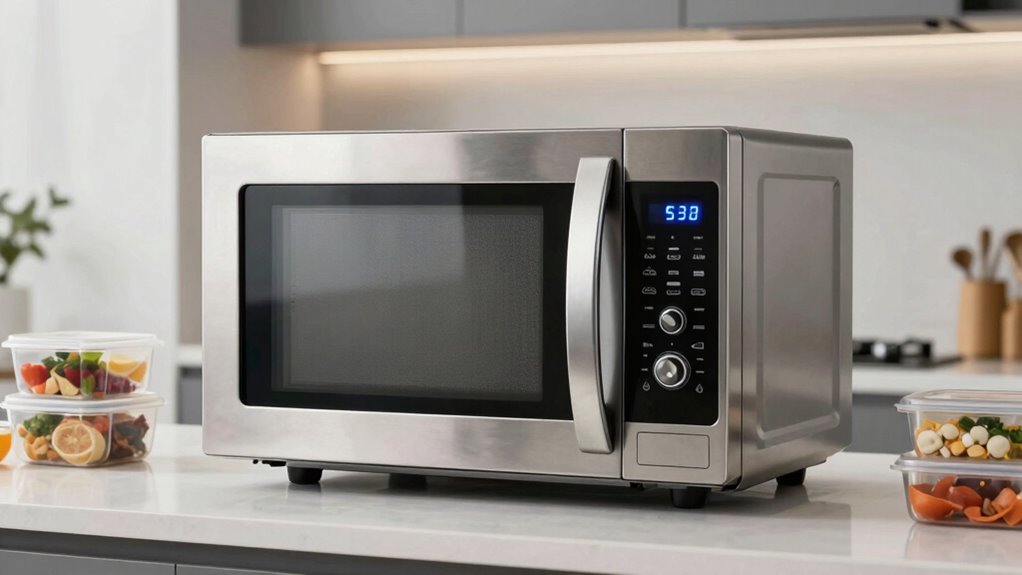

For meal prep and hosting, the Sharp R-CD2200M is my best overall pick among these commercial microwaves, pairing the lineup’s highest listed output with a compact 0.75-cubic-foot cavity. The Amana HDC212 is another standout for heavy-duty use, while the Panasonic NE-1054F suits buyers who want a lower-power, more modest-capacity option for everyday reheating. The main tradeoff is between fast batch service and the space, electrical capacity, and workflow a high-output oven demands. Cavity size and duty rating matter just as much as wattage when you are heating several portions or serving guests. Read on for how I rank all 11 options and what to check before choosing one.

Get kitchen staples and gadgets delivered free with Prime
- Fast, free delivery on millions of items
- Prime Video, Amazon Music and more included
- Member-only deals all year
Key Takeaways
- The Sharp R-CD2200M leads this comparison on listed power at 2200 W, but its 0.75-cubic-foot cavity means high output does not equal room for oversized dishes.
- The Amana HDC212 combines a 2100 W rating with a heavy-duty designation, making it a strong alternative when repeated use matters more than maximizing cavity volume.
- The Panasonic NE-1054F and 1000 W models prioritize lower output; they may fit lighter meal-prep routines better, but large batches can take longer.
- The two CROSSON ovens share a 34 L capacity and 1000 W rating, so buyers should compare their listing details and certification claims rather than assume a meaningful performance difference.
- This lineup spans compact high-power ovens and larger, lower-power choices, so tray dimensions, electrical requirements, and expected cooking cycles can change the best fit more than brand alone.


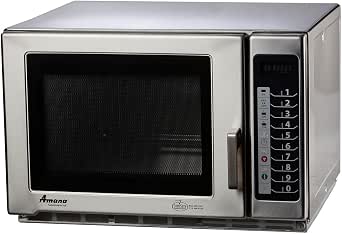


| high ticket commercial microwave oven for meal prep and hosting | Capacity | Power levels | Voltage | Dimensions |
|---|---|---|---|---|
| Sharp R-CD2200M Commercial Mic | 0.75 cubic feet (also listed as 0.7 cubic feet) | — | 208 volts | 13.62 in D × 22.56 in W × 17.52 in H |
| Amana HDC212 Heavy-Duty Commer | 0.6 cubic feet | 11 | 208/240 V | 21.6 × 16.5 × 13.5 inches (D × W × H) |
| Panasonic NE-1054F Commercial | 0.8 cubic feet | Six | 110 volts | — |
| Sharp R25JTF Commercial Microw | 0.7 cubic feet | 11 | 230 volts | 20.47 × 20.13 × 13.2 inches (D × W × H) |
| Sharp R-CD1800M Commercial Mic | 0.75 cubic feet | 11 | — | 13.62 in D × 22.56 in W × 17.52 in H |
| Amana RFS18TS Commercial Micro | 1.2 cubic feet | 5 | 240 volts | 30 × 30 × 14.4 inches (D × W × H) |
| CROSSON Commercial Countertop | 34 liters | 5 | 120 volts | 19.21 × 21.77 × 13.5 inches (D × W × H) |
| CROSSON UL and NSF Listed Comm | 34 liters (1.2 cubic feet) | 5 | 120 V | — |
| Sharp R-CD1200M Commercial Mic | 0.75 cubic feet | 4 | 120 volts | 13.69 × 20.5 × 17.52 inches (D × W × H) |
| Sharp R-21LCFS Medium-Duty Com | 1.0 cubic foot | 1 | 120 volts | 16 × 20.5 × 12.13 inches (D × W × H) |
| Amana Commercial HDC12A2 Heavy | 0.6 cubic feet | 11 | — | 21.6 x 16.5 x 13.5 inches (D x W x H) |
More Details on Our Top Picks
Sharp R-CD2200M Commercial Microwave Oven, 2200 W, 0.75 cu. ft., Stainless Steel
The Sharp R-CD2200M leads this group for kitchens that need fast, repeatable heating across many portions. Its 2200-watt output is the highest here, and quantity pads can adjust heating for double or triple batches—a useful fit for catering prep and busy hosting. Up to 100 stored settings and four-stage cooking also give staff repeatable routines without limiting every task to a single cook step. Compared with the Sharp R-CD1800M, this model adds 400 watts of output, while retaining a similar compact cavity and programming approach. That speed comes with a tight 0.75-cubic-foot interior, so it suits plates and smaller containers better than oversized serving dishes. At 78 pounds, it is also a substantial countertop appliance, and the capacity is inconsistently listed as 0.7 or 0.75 cubic feet.
Pros:- 2200 watts supports quick reheating during high-volume service
- Stores up to 100 cooking memories with four-stage programming
- Double- and triple-quantity pads simplify repeated batch heating
- Stainless steel construction, self-diagnostics, and auto voltage sensor
Cons:- 0.75-cubic-foot cavity limits the size of dishes that fit
- 78-pound weight makes installation and relocation difficult
- Capacity is listed as both 0.7 and 0.75 cubic feet
Best for: Caterers and busy hosts reheating repeated small-to-medium portions who can use the 100 memories and quantity pads.
Not ideal for: Kitchens that regularly heat large platters or need a lighter unit; its cavity is compact and the oven weighs 78 pounds.
- Power:2200 watts
- Capacity:0.75 cubic feet (also listed as 0.7 cubic feet)
- Voltage:208 volts
- Dimensions:13.62 in D × 22.56 in W × 17.52 in H
- Weight:78 pounds
- Programming:Four-stage cooking; up to 100 memories
- Quantity settings:Double and triple quantity pads
- Construction:Stainless steel interior and exterior
Our verdict“Choose the R-CD2200M for high-throughput meal prep and portion-based hosting when speed matters more than cavity size or easy portability.”
Amana HDC212 Heavy-Duty Commercial Countertop Microwave Oven, 0.6 cu. ft., 2100 W
The Amana HDC212 is the space-planning pick: its stackable design can free counter area for prep, plating, or serving while keeping 2100 watts available for rapid heating. For repeatable meal-prep workflows, its 100 memories and four-stage cooking cover much of the programming capability of the Sharp R-CD2200M. The Amana also offers 11 power levels, giving cooks more adjustment choices than the Sharp’s four. The tradeoff is a notably small 0.6-cubic-foot cavity, narrower even than the other compact heavy-duty options here, so large meal-prep containers and hosting platters are poor matches. Its ceramic shelf helps contain spills, but the oven still weighs 65 pounds; stacking and placement should be planned rather than treated as casual rearrangement. A three-year warranty is specified, though buyers should check the fit and electrical requirements for their kitchen.
Pros:- Stackable design can conserve valuable countertop space
- 2100-watt output supports fast service
- 100 memory settings and four-stage cooking suit repeatable workflows
- 11 power levels and ceramic shelf offer useful control and spill containment
Cons:- Smallest listed cavity in this group at 0.6 cubic feet
- 65-pound weight makes placement and movement less convenient
- 208/240 V electrical specification may not fit every kitchen setup
Best for: Commercial kitchens or dedicated prep rooms with limited counter space, repeated small-container reheating, and a need for stackable equipment.
Not ideal for: Hosts reheating wide platters or meal-prep cooks relying on large containers; the 0.6-cubic-foot cavity is restrictive.
- Capacity:0.6 cubic feet
- Output power:2100 watts
- Voltage:208/240 V
- Power levels:11
- Memory settings:100
- Cooking stages:Four
- Dimensions:21.6 × 16.5 × 13.5 inches (D × W × H)
- Weight:65 pounds
- Warranty:Three years
Our verdict“Pick the HDC212 when stackability and programmed small-batch service matter more than fitting larger dishes.”
Panasonic NE-1054F Commercial Countertop Microwave Oven, 1000W, 0.8 cu. ft., Stainless Steel
The Panasonic NE-1054F favors easier placement and a roomier cavity over the high output of the heavy-duty Sharp and Amana models. At 34 pounds, it is far lighter than the 65-pound HDC212 and 78-pound R-CD2200M, which makes it a more practical fit for offices, smaller prep counters, or kitchens that need to move equipment occasionally. Its 0.8-cubic-foot capacity is also larger than those two, and the no-turntable bottom energy feed leaves a flat cooking surface for containers. The compromise is clear: 1000 watts and 10 programmable pads offer less throughput and fewer stored routines than the 2100- and 2200-watt alternatives. It is a commercial-use choice for modest batch sizes, not a substitute for high-speed service when many orders arrive together.
Pros:- 34-pound weight is much easier to place than the heavy-duty alternatives
- 0.8-cubic-foot capacity exceeds the listed capacities of the Sharp R-CD2200M and Amana HDC212
- No-turntable bottom energy feed provides a flat surface for containers
- Braille touch controls and NSF and UL commercial approvals
Cons:- 1000 watts is substantially lower output than the heavy-duty models in this roundup
- Only 10 programmable pads and 20 memories limit stored workflows
- Not suited to fast, high-volume batch service
Best for: Small food-service teams, office kitchens, and hosts who want commercial construction and a flat-bottom cavity without heavy-duty output.
Not ideal for: High-volume caterers or kitchens reheating many portions at once; its 1000-watt power and 10 programmable pads are more limited than the Sharp R-CD2200M.
- Model:NE-1054F
- Power:1000 watts
- Capacity:0.8 cubic feet
- Voltage:110 volts
- Weight:34 pounds
- Power levels:Six
- Programmable memory:10 pads; 20 memories
- Interior dimensions:8-1/16 in H × 13 in W × 13 in D
- Heating method:No-turntable bottom energy feed
Our verdict“Choose the NE-1054F for lighter commercial meal prep where compact handling and a flat cavity matter more than maximum speed.”
Sharp R25JTF Commercial Microwave Oven, 2100 W, 0.7 cu. ft., Stainless Steel
The Sharp R25JTF suits kitchens that want substantial output with more adjustment options than a simple high-power reheater. Its 2100 watts and 11 power levels give cooks more control over delicate or varied foods than the R-CD2200M, which lists four levels. It also supports 20 program inputs and three-stage cooking, a useful middle ground for repeatable prep without the Sharp R-CD2200M’s 100-memory capacity. Express Defrost and a lighted digital display add practical help during a busy shift. Against the Amana HDC212, it offers a larger 0.7-cubic-foot cavity, though still not much room for large hosting platters. The 77-pound body is heavy, and its specified 230-volt supply may call for a compatible commercial circuit. Buyers should check that electrical fit before choosing it.
Pros:- 2100 watts supports quick reheating and prep
- 11 power levels provide more adjustment than the R-CD2200M
- Three-stage cooking and 20 program inputs support repeatable routines
- Express Defrost and lighted digital display aid busy service
Cons:- 0.7-cubic-foot capacity limits larger dishes
- 77-pound weight makes repositioning difficult
- 230-volt specification may require a compatible kitchen circuit
Best for: Food-service teams that prepare varied foods and value multiple power levels, staged cooking, and clear controls.
Not ideal for: Kitchens needing broad memory storage, a lightweight unit, or standard household electrical compatibility; it has 20 programs, weighs 77 pounds, and specifies 230 volts.
- Power:2100 watts
- Capacity:0.7 cubic feet
- Voltage:230 volts
- Power levels:11
- Program inputs:20
- Cooking stages:Three
- Dimensions:20.47 × 20.13 × 13.2 inches (D × W × H)
- Weight:77 pounds
- Defrost:Express Defrost
Our verdict“Choose the R25JTF for varied commercial prep that benefits from fine power adjustment, provided its electrical requirements fit your kitchen.”
Sharp R-CD1800M Commercial Microwave Oven, 1800 Watts, 0.75 Cu. Ft., Stainless Steel
The Sharp R-CD1800M keeps the useful batch workflow of the R-CD2200M while stepping down to 1800 watts. It still offers up to 100 custom memories, four-stage cooking, and double- and triple-quantity options, so hosts or prep teams can repeat portion routines without entering settings each time. Compared with the R-CD2200M, the lower output means less emphasis on peak speed; in return, this model retains 11 power levels, whereas the R-CD2200M lists four. Its 0.75-cubic-foot cavity is compact, but it shares the same listed outer dimensions as that more powerful Sharp, so counter planning matters. The manual defrost system is a drawback for kitchens that frequently move frozen ingredients into service, and the source data does not specify voltage. This is a workflow-focused pick rather than the fastest option for surges.
Pros:- Stores up to 100 custom cooking memories
- Four-stage cooking supports multi-step programmed routines
- Double- and triple-quantity settings help scale repeated portions
- 11 power levels offer more adjustment than the R-CD2200M
Cons:- 1800 watts is lower output than the R-CD2200M and other heavy-duty options here
- 0.75-cubic-foot capacity restricts larger plates and serving dishes
- Manual defrost requires more operator attention
Best for: Hosts and small commercial prep teams that repeat the same small-portion recipes and want extensive memory programming without prioritizing maximum wattage.
Not ideal for: High-volume kitchens needing the fastest heating or automatic defrost; the R-CD2200M offers greater output, and this model uses manual defrost.
- Wattage:1800 watts
- Capacity:0.75 cubic feet
- Dimensions:13.62 in D × 22.56 in W × 17.52 in H
- Power levels:11
- Programming:Four-stage cooking
- Preset programs:10
- Custom memory settings:Up to 100
- Quantity settings:Double and triple quantity options
- Defrost:Manual
Our verdict“Choose the R-CD1800M for repeatable batch reheating and flexible power control when the R-CD2200M’s extra speed is not needed.”
Amana RFS18TS Commercial Microwave, 1800 Watts
For meal prep that needs to keep pace with a busy service or a large gathering, the Amana RFS18TS pairs 1800 watts with a 1.2-cubic-foot cavity. That combination gives it more cooking power and usable space than the compact Sharp R-CD1200M, making it better suited to repeated batches and larger dishes. Its 18 cooking programs, five power levels, and auto defrost offer more flexibility than the dial-driven Sharp R-21LCFS, which has only one power level. The tradeoff is the electrical setup: this Amana requires 240 volts, so it is not a simple plug-in replacement for a standard household microwave. Its listed dimensions also call for careful counter and installation planning. I’d choose it when throughput and programmed cooking matter more than easy installation.
Pros:- 1800 watts supports faster heating for repeated service
- 1.2-cubic-foot capacity accommodates larger meal-prep loads than compact commercial models
- 18 cooking programs and five power levels offer flexible repeat cooking
- Auto defrost adds a useful option for frozen ingredients
Cons:- Requires a 240-volt power supply, limiting where it can be installed
- Listed 30 × 30-inch footprint demands substantial counter or installation space
Best for: Caterers, community kitchens, and hosts who prepare repeated batches and already have access to a 240-volt connection.
Not ideal for: Home cooks with standard 120-volt outlets or limited counter space; its power requirement and listed 30-inch width make placement a serious constraint.
- Power:1800 watts
- Voltage:240 volts
- Capacity:1.2 cubic feet
- Dimensions:30 × 30 × 14.4 inches (D × W × H)
- Power levels:5
- Cooking programs:18
- Defrost:Auto defrost
- Interior material:Stainless steel
Our verdict“Choose the RFS18TS for high-volume prep and hosting when you can support its 240-volt electrical requirement and large footprint.”
CROSSON Commercial Countertop Microwave Oven, 34 L, 1000 W, Stainless Steel
The dial-controlled CROSSON is the more approachable pick for a shared kitchen where several people need to reheat food without learning a menu system. Its 34-liter capacity and 120-volt connection make it more practical for many countertop setups than the higher-output Amana RFS18TS, which needs 240 volts. Five dial-selected power levels give users basic control, while the heat circulation system and auto-reset timer support routine use during a busy meal period. Compared with the button-controlled CROSSON 34 L model, this version favors simple operation over saved programmable menus, so it is less suited to repeating precise multi-stage recipes. At 39.2 pounds, it is also a substantial appliance to move, and the dial interface may feel limiting to kitchens that want stored cooking routines.
Pros:- 34-liter capacity supports larger reheating loads
- 120-volt operation suits more countertop locations than the 240-volt Amana RFS18TS
- Five dial-controlled power levels provide straightforward adjustments
- Auto-reset timer helps limit continued cooking after the door is opened
Cons:- Dial controls do not store custom menus like the button-controlled CROSSON 34 L model
- 39.2-pound weight makes repositioning difficult
- 1000-watt output is less suited to buyers prioritizing faster high-volume heating
Best for: Shared kitchens and frequent home hosts who want a large-capacity commercial-style microwave with familiar dial controls and a standard 120-volt connection.
Not ideal for: Kitchens that need saved menus or multi-stage cooking, or users who need to move the microwave regularly.
- Capacity:34 liters
- Wattage:1000 watts
- Voltage:120 volts
- Power levels:5
- Controller:Dial
- Dimensions:19.21 × 21.77 × 13.5 inches (D × W × H)
- Weight:39.2 pounds
- Interior material:Ceramic
- Certifications:UL and NSF listed
Our verdict“Pick this CROSSON for sizable everyday batches and simple shared operation, not for programmable cooking workflows.”
CROSSON UL and NSF Listed Commercial Countertop Microwave Oven, 34 L, 1000 W
For a hosting routine built around the same dishes and portions, this CROSSON’s 10 programmable menus and three-stage cooking offer a practical advantage over the dial-only CROSSON 34 L. Button controls let a kitchen save repeat settings instead of asking each user to recreate them, while the 34-liter cavity provides room for larger prep loads than the Sharp R-CD1200M’s 0.75-cubic-foot interior. The 120-volt connection is also easier to accommodate than the Amana RFS18TS’s 240-volt requirement. However, this is not a compact choice: its 39.2-pound weight and substantial countertop dimensions need planning. The listing gives both 1000 W microwave output and 1500 W listed wattage, so buyers comparing electrical and cooking figures should treat those as distinct stated values rather than assuming they mean the same thing.
Pros:- Ten programmable menus reduce repeated manual entry
- Three-stage cooking allows stored sequences with changing times or power levels
- 34-liter capacity is roomier than the Sharp R-CD1200M
- UL and NSF listings suit commercial-oriented kitchen settings
Cons:- Large footprint and 39.2-pound weight make placement and repositioning difficult
- Listed wattage is 1500 W while stated microwave output is 1000 W
- Programmable button controls may take more setup than the dial CROSSON
Best for: Meal-prep teams and frequent hosts who repeat the same cooking sequences and want a large cavity with programmable controls.
Not ideal for: Small kitchens, buyers who want a lightweight appliance, or those who need a single unambiguous wattage figure before choosing equipment.
- Capacity:34 liters (1.2 cubic feet)
- Microwave output:1000 W
- Listed wattage:1500 W
- Voltage:120 V
- Power levels:5
- Programmable menus:10
- Cooking stages:3
- Controls:Buttons
- Sanitation listing:UL and NSF
Our verdict“Choose this model when repeatable menus matter more than saving counter space or keeping the controls as simple as possible.”
Sharp R-CD1200M Commercial Microwave Oven
The Sharp R-CD1200M is built around repeatability rather than cavity size. Its 10 memory pads can hold up to 100 custom settings, and four-stage cooking lets staff run a defined sequence with fewer manual adjustments. That makes it a stronger fit for a hosting operation with recurring portions than the simpler Sharp R-21LCFS, whose dial timer and single power level favor quick, basic heating. The R-CD1200M’s 1200 watts also exceed the R-21LCFS’s 1000 watts, but its 0.75-cubic-foot cavity remains compact beside either 34-liter CROSSON. Double- and triple-quantity controls can help scale stored routines, though they do not change the physical limit on dish size. I’d favor this Sharp when menu consistency matters more than fitting large platters or preparing several portions at once.
Pros:- Stores up to 100 custom settings across 10 memory pads
- Four-stage cooking supports more controlled repeat sequences than the Sharp R-21LCFS
- Double and triple quantity controls aid scaling stored settings
- Stainless-steel interior and exterior simplify routine cleaning
Cons:- 0.75-cubic-foot capacity limits larger dishes and batch size
- 1200 watts is below the 1800-watt Amana RFS18TS
- Memory-based workflow is less direct for users who only need basic manual reheating
Best for: Small restaurants, caterers, and hosts with a repeated menu who want programmable cooking routines and quantity controls in a compact commercial unit.
Not ideal for: Large-family meal preppers or hosts serving wide dishes; the 0.75-cubic-foot capacity can restrict load size compared with the CROSSON 34 L models.
- Wattage:1200 watts
- Capacity:0.75 cubic feet
- Voltage:120 volts
- Power levels:4
- Memory pads:10
- Custom settings:Up to 100
- Cooking stages:4
- Dimensions:13.69 × 20.5 × 17.52 inches (D × W × H)
- Material:Stainless steel interior and exterior
Our verdict“Choose the R-CD1200M when saved cooking routines and portion scaling matter more than a roomy cavity.”
Sharp R-21LCFS Medium-Duty Commercial Microwave Oven, Stainless Steel, 1000 W
When the job is mainly reheating a platter without programming menus, the Sharp R-21LCFS keeps the workflow direct: set its dial timer from 10 seconds to 6 minutes, heat, and let the door-open cancellation stop the remaining time. Its 1.0-cubic-foot interior and 13.5-inch platter capacity make it more accommodating for a single serving dish than the compact Sharp R-CD1200M, though that model offers memory pads and four-stage cooking for repeatable service. The R-21LCFS runs on 120 volts, unlike the high-output Amana RFS18TS, and its stainless-steel interior and exterior suit frequent cleanup. The tradeoff is sparse control: one power level and manual defrost leave little room for gentler cooking or more involved meal-prep sequences. This is a practical basic unit, not a programmable workhorse.
Pros:- 1.0-cubic-foot capacity accommodates a 13.5-inch platter
- Simple dial timer is easy to operate without menu setup
- Door opening cancels remaining cooking time
- Stainless-steel interior and exterior are suited to frequent cleaning
Cons:- Single power level limits cooking flexibility compared with the Sharp R-CD1200M
- Manual defrost requires user attention
- 1000-watt output is less suited to high-volume service than the Amana RFS18TS
Best for: Hosts and small food-service teams that mainly reheat dishes on platters and prefer a simple timer over stored cooking programs.
Not ideal for: Meal-prep users who need multiple power levels, automatic defrost, or programmed multi-stage recipes.
- Capacity:1.0 cubic foot
- Power:1000 watts
- Voltage:120 volts
- Timer:Dial, 10 seconds to 6 minutes
- Power levels:1
- Defrost:Manual
- Turntable diameter:13.5 inches
- Dimensions:16 × 20.5 × 12.13 inches (D × W × H)
- Warranty:3 years on magnetron; 1 year
Our verdict“Choose the R-21LCFS for straightforward platter reheating, but skip it if your meal prep depends on flexible power settings or saved recipes.”
Amana Commercial HDC12A2 Heavy-Duty Microwave Oven, 1200W, Stainless Steel
I’d choose the Amana HDC12A2 for a prep station where repeatable heating matters more than fitting large dishes. Its 100 cooking programs and 11 power levels give staff a way to standardize common tasks, while the stainless steel interior and exterior suit frequent cleanup. For hosting, its 1200 watts provide more capacity for quick service than the 1000-watt Panasonic NE-1054F, but it doesn’t reach the output of the 2100-watt Amana HDC212 or the 2200-watt Sharp R-CD2200M. The main compromise is the 0.6-cubic-foot cavity: it works for individual portions and smaller prep batches, not bulky platters. At 67 pounds, it is also a substantial countertop appliance to place and reposition.
Pros:- 100 cooking programs support repeatable preparation for frequently served items.
- 11 power levels allow more control than a basic single-setting microwave.
- Stainless steel interior and exterior are suited to regular commercial cleanup.
- 1200 watts offer more output than the 1000-watt Panasonic NE-1054F.
Cons:- The 0.6-cubic-foot cavity limits dish size and batch volume.
- At 67 pounds, it is difficult to move after countertop placement.
- Its 1200-watt output is below the 1800- to 2200-watt alternatives in the lineup.
Best for: Caterers and busy household hosts who repeatedly heat individual portions or small batches and want programmable consistency with a stainless steel cooking chamber.
Not ideal for: Hosts who need to reheat large serving dishes or cooks seeking the highest throughput; its 0.6-cubic-foot capacity and 1200-watt output trail larger or more powerful options such as the Amana HDC212.
- Power:1200 watts
- Capacity:0.6 cubic feet
- Power levels:11
- Cooking programs:100
- Dimensions:21.6 x 16.5 x 13.5 inches (D x W x H)
- Weight:67 pounds
- Material:Stainless steel interior and exterior
- Installation:Countertop
- Origin:Made in the USA
Our verdict“Choose this Amana for programmed, repeatable small-batch prep, but pick a higher-wattage or larger-capacity model for faster service or bigger hosting dishes.”
How We Picked
I ranked these ovens for the specific demands of batch reheating, meal prep, and serving guests, not for home countertop convenience alone. The comparison weighs stated wattage, cavity capacity, and duty classification alongside how those details may affect throughput, portion size, and day-to-day usability. I also considered the practical costs of high-output operation: space, compatible electrical service, cleaning access, and whether a heavy-duty design makes sense for the expected workload.
The ranking favors models that appear better suited to recurring, time-sensitive service, while recognizing that the most powerful oven is not automatically the best choice for every kitchen. A lower-power model can rank well for lighter use or a more modest footprint, while an oven with a larger stated capacity may suit wider dishes better than a compact high-output unit. Where two models have closely matched listed specifications, I distinguish them cautiously and recommend verifying exact controls, certifications, installation requirements, and manufacturer support before purchase.
Factors to Consider When Choosing High Ticket Commercial Microwave Oven For Meal Prep And Hosting
Choosing a commercial microwave for a home meal-prep station or a hosting kitchen means balancing service speed, dish fit, and installation limits. These broader checks can prevent a mismatch that wattage alone will not reveal.
Match Wattage to Your Real Batch Pattern
Wattage can influence how quickly a microwave reheats food, but the result also depends on portion size, food density, starting temperature, and how evenly the oven heats. If you prepare multiple portions in sequence, higher output may help keep service moving; if you heat only occasional plates, the added power may not earn its place. A common mistake is comparing wattage without accounting for whether you will reheat one large batch or many small containers. Think through your busiest meal period and estimate how many heating cycles you need to complete. Also check the manufacturer’s electrical requirements rather than assuming a high-wattage unit will work on any available outlet.
Check the Cavity Against Your Actual Dishes
Capacity figures do not tell the whole story: turntable or cavity layout, interior width, and usable height determine whether your everyday trays and serving dishes fit. Measure the widest container you plan to use, including handles, and compare it with the manufacturer’s interior dimensions. This matters especially for hosting, when a broad casserole may be more useful than several individually reheated plates. Do not assume that a compact oven with high wattage can accommodate large cookware simply because it reheats quickly. Leave enough clearance around containers for safe placement and easy removal.
Choose Duty Level for Frequency, Not Ambition
A heavy-duty designation is most relevant when the oven will run repeatedly across a long service period, such as a busy catering prep area or a household that hosts often. For occasional batch cooking, a medium-duty model may meet the workload without taking on a heavier commercial footprint. Buyers sometimes pay for a duty class they will rarely use, or choose a lighter-duty model for cycles that happen all day. Base the decision on actual daily use, not the maximum scenario you can imagine. Review the manufacturer’s guidance for duty cycle, intended setting, and warranty conditions before committing.
Plan the Electrical and Countertop Setup First
Commercial ovens can place different demands on a kitchen than a standard household microwave, particularly when output is high. Confirm voltage, amperage, plug type, and circuit requirements with the product documentation and a qualified electrician if needed. Measure the countertop footprint and the space needed for ventilation, door swing, and routine access. A common buying error is focusing on the appliance dimensions while overlooking the surrounding clearance or the circuit shared with other equipment. For hosting, placement also affects how easily someone can load and unload the oven without interrupting food prep.
Compare Controls and Cleaning for Shared Use
When several people will use the oven, straightforward controls can reduce mistakes and keep reheating consistent. Look at how programs are set, whether the control panel suits your workflow, and whether staff or family members can learn it quickly. Stainless steel construction may support commercial-style cleaning, but seams, corners, and frequently touched controls still need regular attention. Consider how often you will wipe the interior and whether the door and cavity are easy to reach. A feature set that sounds advanced is of little value if it slows down the person responsible for service.
Verify Certifications and Service Support
Certification claims can matter for commercial kitchens, shared facilities, and buyers working under local inspection rules. Check the exact model’s listing and confirm that any required certification applies to the appliance configuration you are ordering; similar names do not guarantee identical documentation. Also research parts availability, authorized service options, and warranty coverage before a busy season. A low-use kitchen may tolerate a longer service interruption than a catering operation that depends on rapid reheating. Keep the model number and installation requirements on hand so you can confirm compatibility with your venue or local authority.
Frequently Asked Questions
Is a 2200 W commercial microwave worth choosing for home meal prep?
It can make sense if you regularly reheat many portions in sequence or need to keep a hosting service moving. The Sharp R-CD2200M has the highest stated output in this lineup, but its 0.75-cubic-foot cavity still limits the size of dishes it can take. Check your electrical service and cookware dimensions before deciding that more wattage is the main need. For lighter use, a 1000 W model may be a more practical fit, even if individual cycles take longer. Match power to your weekly workload rather than choosing the largest figure by default.
Should I prioritize cavity capacity or wattage for serving a group?
Prioritize the factor that limits your current workflow: dish fit or service speed. A larger cavity can accommodate wider containers, while higher wattage may help with repeated reheating, though neither guarantees faster or more even results for every food. If you often serve shared dishes, measure those containers and compare interior dimensions first. If you mostly heat individual meal-prep portions one after another, output and duty rating may matter more. Many buyers should check both before narrowing the shortlist.
Can I plug a commercial microwave into a standard household outlet?
Do not assume that you can. Electrical needs vary by model, and higher-output commercial ovens may require a specific circuit, voltage, or plug configuration. Read the manufacturer’s installation documentation and compare it with the outlet and circuit available in your kitchen. When the requirements are unclear, have a qualified electrician check the setup before delivery. Confirming this early can prevent installation delays or an appliance that cannot be used safely in its intended location.
Do I need a heavy-duty model if I host only on weekends?
Not automatically. The relevant question is how many heating cycles the oven will handle during those hosting periods and whether it will also support routine meal prep. A heavy-duty model such as the Amana HDC212 is aimed at demanding repeated use, while a lighter-duty option may be adequate for occasional batches. If a weekend gathering involves continuous service for hours, duty rating deserves more weight than the number of days used. Check the manufacturer’s use guidance rather than treating the label as a guarantee for every workload.
How should I choose between the two 34 L CROSSON models?
The supplied specifications list both as 34 L and 1000 W, so those figures alone do not establish a clear performance winner. The UL and NSF listing claim on one version may matter if your kitchen or local rules require that documentation, but verify the exact model and certification before ordering. Compare control options, dimensions, electrical requirements, warranty terms, and service support in the current product documentation. If certification is not relevant to your setting, prioritize the model whose installation and support details fit your kitchen best. Avoid inferring differences that are not confirmed by the listings.
Conclusion
For the strongest all-around fit for frequent meal prep and hosting, I would start with the Sharp R-CD2200M, provided its electrical needs and compact cavity suit your kitchen. For a heavy-duty alternative, the Amana HDC212 is my pick for repeated service; for a premium high-output focus, compare it with the Sharp R25JTF and confirm the controls and installation details that matter to you. Buyers seeking value should look first at the Sharp R-CD1800M or Amana RFS18TS as lower-output commercial options, then verify current specifications and support before deciding. For beginners or lighter workloads, the Panasonic NE-1054F offers a more modest 1000 W starting point. If wide dishes or a larger cavity are your priority, compare the stated capacity and actual interior dimensions of the CROSSON 34 L models; choose the UL/NSF-listed version only if its verified certification fits your requirements.