For a high-ticket commercial stand mixer for baking and dough prep, I’d start with the Waring Commercial Luna 20-quart as the best overall balance of capacity and timed planetary mixing. The BREVELTION 50-quart stands out for high-volume bakery or pizzeria work, while the Ooni Halo Pro is a distinct choice for dough-focused mixing and fine speed control. The main tradeoffs are batch size, mixer type, electrical and space requirements, and how much versatility you need beyond dough. A larger bowl is not automatically better if your regular batches are small, and a planetary mixer may suit varied baking tasks better than a dedicated spiral design. Continue reading for the full comparison and guidance on matching a mixer to your workload.

Get kitchen staples and gadgets delivered free with Prime
- Fast, free delivery on millions of items
- Prime Video, Amazon Music and more included
- Member-only deals all year
Complete the kit


Key Takeaways
- The Waring Luna 20-quart leads this roundup for buyers seeking a middle ground between smaller shop mixers and 30- to 50-quart machines, with a digital timer adding practical control.
- The BREVELTION 50-quart is the clear large-batch option on listed capacity and motor power, but its size and specialized scale make it a poor fit for many small kitchens.
- The Ooni Halo Pro differs from the planetary-heavy field with a spiral-mixer approach and many speed settings, which may better suit dough-centered work than buyers needing an all-purpose mixer.
- Several 30-quart mixers share similar headline specs, including three speeds and 1250W; bowl capacity alone does not settle the choice, so buyers should compare controls, construction, service, and compatibility.
- The two KitchenAid Commercial 8-quart listings and smaller Waring and Winco models point to a different priority: a more manageable footprint and smaller batches rather than maximum throughput.




| high ticket commercial stand mixer for baking and dough prep | Motor power | Capacity | Dimensions | Speeds |
|---|---|---|---|---|
| Waring Commercial Luna Planeta | 1 horsepower | 20 quarts | — | — |
| VEVOR 15Qt Commercial Food Mix | 500W | — | 18.7 in D × 14.8 in W × 27 in H | 3; listed at 113, 184, and 341 RPM |
| Waring Luna Planetary Stand Mi | 3/4 horsepower | 10 quarts | 14.25 in × 23.625 in × 18.5 in | — |
| Commercial Food Mixer 30Qt | 1250W | 30 quarts | 21.6 in D × 17.7 in W × 30.1 in H | 3 |
| KitchenAid Commercial Series 8 | 1.3 HP | 8 quarts | 13.3 in D × 16.5 in W × 14.6 in H | 10 |
| 15qt 600W Commercial Food Mixe | — | — | — | 3 |
| Winco 10 L White Commercial-Gr | 750 W | — | 19.09 × 19.69 × 12.99 inches | 3 |
| VEVOR Commercial Food Mixer 20 | 1100 W | — | 20.98 × 18.19 × 30.71 inches | 3: 130, 193, and 458 RPM |
| Ooni Halo Pro Spiral Mixer | 650 W | 7.3 qt | 9.9 × 17.2 × 13.5 inches | — |
| Commercial Food Mixer 30Qt | 1250 W | — | — | 3: 100, 166, and 360 RPM |
| KitchenAid Commercial 8-Quart | 1.3 HP | — | — | — |
| BREVELTION 50Qt Commercial Dou | — | 50 quarts | 30.3" D × 30.3" W × 35.4" H | — |
| EKway 30qt Commercial Food Mix | — | 30 quarts; up to 13.22 lb (6 kg) of dough | — | 3 |
| LEEVOT Commercial 30QT Heavy D | 1250 W | 30 quarts | 22" D × 17.7" W × 31.5" H | — |
| Winco 20 L Commercial-Grade Pl | — | 20 liters | — | — |
More Details on Our Top Picks
Waring Commercial Luna Planetary Stand Mixer – 20-Quart, 1 HP Motor with Digital Timer (WSM20LT)
The Waring Luna 20-quart earns my overall pick because its 1 HP motor, large bowl, and integrated digital timer address the needs of a busy bakery without moving up to a 30-quart machine. Its three-speed control and dough hook, paddle, and whisk cover bread dough as well as batters and lighter mixtures. Compared with the Waring Luna 10 Qt, it offers twice the listed capacity and more motor power, which suits larger production runs; the smaller model is easier to fit where batches stay modest. The 20-quart capacity still falls short of the 30-quart BOSBAK for operations that regularly mix very large dough loads. The tradeoff is its bulky, heavy build: it needs a dedicated counter spot, and moving it around can be difficult. I’d choose it for sustained, varied production rather than occasional small batches.
Pros:- 1 HP motor is specified for demanding mixing and dough work.
- 20-quart stainless steel bowl supports larger batches than the Waring Luna 10 Qt.
- Integrated digital timer allows timed mixing without constant attention.
- Dough hook, chef’s whisk, and mixing paddle cover varied preparation tasks.
Cons:- Bulky footprint can be difficult to accommodate on a crowded counter.
- Heavy construction makes repositioning and storage challenging.
- Its capacity is below the 30-quart BOSBAK for kitchens handling the largest batches.
Best for: Small bakeries and foodservice kitchens that need to make substantial batches of both dough and batter, with a timer to reduce hands-on monitoring.
Not ideal for: Home bakers or cramped prep areas that lack room for a heavy, 20-quart commercial mixer.
- Capacity:20 quarts
- Motor power:1 horsepower
- Speed settings:3-speed variable control
- Bowl material:Stainless steel
- Timer:Integrated digital timer
- Included attachments:Dough hook, chef’s whisk, mixing paddle
- Model:WSM20LT
Our verdict“Choose the Waring Luna 20-quart for a commercial kitchen needing strong, versatile batch capacity without stepping up to a 30-quart mixer.”
VEVOR 15Qt Commercial Food Mixer Timing Function 500W Commercial Mixer
The VEVOR 15Qt is a practical fit for a pizzeria, café, or compact bakery that wants a commercial-style planetary mixer without the footprint and capacity of the 20- and 30-quart options. Its 15-quart bowl is listed for up to 3.3 pounds of food at a time, a useful batch ceiling to check against your recipes before buying. The 500W gear-driven motor, three speeds, and hook, beater, and whisk support dough, fillings, and whipping; the timer can be set for up to 30 minutes. Compared with the Waring Luna 20-quart, it has less capacity and motor power, but its stated output may suit operations with smaller, frequent batches. That modest capacity also means it is not a choice for large dough runs. At 127.9 pounds, it is still a substantial piece of equipment, and the instruction to stop the machine before changing speed adds a workflow constraint.
Pros:- 15-quart stainless steel bowl offers a smaller capacity option than the 20- and 30-quart mixers.
- Dough hook, flat beater, and wire whip handle different mixing tasks.
- Timer knob supports settings up to 30 minutes.
- Bowl and listed food-contact attachments are stainless steel.
Cons:- Listed mixing capacity is limited to 3.3 pounds of food at a time.
- 500W motor is lower-powered than the Waring Luna 20-quart’s 1 HP motor.
- At 127.9 pounds, it is difficult to move despite its smaller capacity.
Best for: Pizzerias, cafés, and small foodservice teams whose routine batches fit within the stated 3.3-pound food capacity.
Not ideal for: Bakeries producing large bread batches or kitchens that need higher capacity and motor power than this 500W, 15-quart unit provides.
- Bowl capacity:15 quarts
- Stated food capacity:Up to 3.3 lb
- Motor power:500W
- Speeds:3; listed at 113, 184, and 341 RPM
- Timer:Up to 30 minutes
- Included attachments:Dough hook, flat beater, wire whip
- Dimensions:18.7 in D × 14.8 in W × 27 in H
- Weight:127.9 lb
Our verdict“Pick the VEVOR 15Qt when your commercial batches are modest and you value a timer and three attachments over high-capacity dough production.”
Waring Luna Planetary Stand Mixer with 10-Quart Capacity
The Waring Luna 10 Qt is the lineup’s more space-conscious commercial choice, keeping the three-quarter-horsepower motor and digital timer of the Luna family in a smaller-capacity format. Its 10-quart bowl and dough hook, flat beater, and wire whip cover routine bakery work, while the stainless steel construction is suited to foodservice use. Compared with the Waring Luna 20-quart, this model gives up capacity and some motor power, so it is better matched to shorter runs than to high-volume dough production. In return, it avoids committing as much bowl capacity and counter space to every batch. Its listed dimensions—14.25 by 23.625 by 18.5 inches—still call for a planned workspace, and it remains a commercial machine rather than an especially small home appliance. I’d favor it over the VEVOR 15Qt when Waring’s stated motor power and a digital timer matter more than bowl size.
Pros:- Three-quarter-horsepower motor offers a substantial commercial-oriented power specification for a 10-quart mixer.
- Digital timer supports repeatable timed mixing.
- Dough hook, flat beater, and wire whip cover dough, batter, and whipping tasks.
- Smaller capacity than the Waring Luna 20-quart can better suit moderate batch sizes.
Cons:- 10-quart capacity limits batch size compared with the 20- and 30-quart mixers.
- Still requires a dedicated workspace, with listed dimensions reaching 23.625 inches in one direction.
- Commercial capacity and format may be more machine than a typical home baker needs.
Best for: Cafés, test kitchens, and small bakeries that need a commercial mixer for moderate batches and have limited room compared with a 20-quart setup.
Not ideal for: High-volume bakeries that routinely need large dough batches; the 10-quart bowl is less capacious than the Waring Luna 20-quart and BOSBAK 30Qt.
- Capacity:10 quarts
- Motor power:3/4 horsepower
- Material:Stainless steel
- Attachments:Dough hook, flat beater, wire whip
- Dimensions:14.25 in × 23.625 in × 18.5 in
- Model:WSM10LT
- Timer:Integrated digital timer
Our verdict“Choose the Waring Luna 10 Qt if your kitchen needs commercial features for moderate batches but cannot justify a 20-quart mixer.”
Commercial Food Mixer 30Qt, Dough Mixer with 3-Speeds, 1250W
For kitchens whose limiting factor is batch size, the BOSBAK 30Qt offers the largest stated bowl capacity among these five picks, with a listed ability to handle up to 22 pounds of dough. Its 1250W motor, three speeds, metal bowl-lifting mechanism, and hook, beater, and whisk make it suited to bread and pizza dough as well as fillings and lighter mixtures. The 60-minute timer with end-of-cycle alert gives it a longer listed timing range than the VEVOR 15Qt’s 30-minute setting. It also adds a splash guard, automatic stop when the guard opens, and overload protection. Compared with the Waring Luna 20-quart, this machine offers more capacity but demands more room and weighs 154.3 pounds. That size is a real operational cost: it needs a fixed position, and its safety instructions call for stopping before adding ingredients during operation.
Pros:- 30-quart bowl is listed for up to 22 pounds of dough.
- 1250W motor and three speeds support varied mixing tasks.
- 60-minute timer includes an end-of-cycle alert.
- Splash guard, automatic safety stop, and overload protection are specified.
Cons:- Large dimensions and 154.3-pound weight make placement and repositioning difficult.
- Requires more space and capacity planning than the Waring Luna 20-quart.
- Instructions require stopping the machine before adding ingredients during operation.
Best for: Bakeries, pizzerias, and restaurants that regularly prepare large dough batches and have space for a 30-quart floor or counter installation.
Not ideal for: Small kitchens or businesses with modest batch needs that cannot use the 30-quart capacity or accommodate a 154.3-pound mixer.
- Capacity:30 quarts
- Stated dough capacity:Up to 22 lb
- Motor power:1250W
- Speeds:3
- Timer:0–60 minutes with end-of-cycle alert
- Included attachments:Dough hook, flat beater, wire whip
- Dimensions:21.6 in D × 17.7 in W × 30.1 in H
- Weight:154.3 lb
- Voltage:110V
Our verdict“Choose the BOSBAK 30Qt if large, recurring dough batches justify its substantial footprint and fixed-workstation feel.”
KitchenAid Commercial Series 8 Quart Bowl-Lift Stand Mixer with Stainless Steel Bowl Guard
The KitchenAid Commercial Series is the most compact-capacity option here, but its 1.3 HP motor, 10 speeds, and NSF certification give it a distinctly commercial profile. Its 8-quart bowl and bowl guard suit smaller foodservice batches where an operator values a familiar bowl-lift format and a broad range of speeds more than high-volume output. Compared with the Waring Luna 10 Qt, it has less bowl capacity but more listed speed settings and a higher stated motor rating; the Waring is the better fit when larger batches take priority. The KitchenAid includes a spiral dough hook, flat beater, and elliptical whip, so it can move between dough and lighter preparations. The tradeoff is clear: an 8-quart bowl cannot compete with the 20- or 30-quart mixers for production runs. The supplied data also lists a 25-pound weight, so confirm the exact model’s handling and installation needs before planning a fixed station.
Pros:- NSF certification and stainless steel bowl guard suit commercial foodservice settings.
- Listed 1.3 HP motor and 10 speeds offer a broad operating range.
- Spiral dough hook, flat beater, and elliptical whip cover several preparation jobs.
- Two-year warranty is included in the supplied specifications.
Cons:- 8-quart bowl limits batch size compared with every other mixer in this group.
- Lower capacity makes it a poor match for large-scale dough production.
- The listed 25-pound weight should be verified for the specific unit when planning placement.
Best for: Cafés, small caterers, and foodservice prep stations making smaller batches that benefit from NSF certification, a bowl guard, and multiple speed settings.
Not ideal for: Commercial bakeries with large daily dough requirements; its 8-quart bowl is substantially smaller than the Waring Luna 10 Qt and larger mixers.
- Capacity:8 quarts
- Motor power:1.3 HP
- Voltage:120V
- Wattage:500W
- Speeds:10
- Dimensions:13.3 in D × 16.5 in W × 14.6 in H
- Included components:Stand mixer, bowl, flat beater, spiral dough hook, elliptical whip
- Warranty:2 years
Our verdict“Pick the KitchenAid Commercial Series for smaller foodservice batches where certification, bowl guarding, and speed choice matter more than capacity.”
15qt 600W Commercial Food Mixer with 3 Speeds and Attachments
The 15-quart bowl and 600 W motor make this a practical middle ground for bakeries that need more capacity than a countertop mixer but do not need a 30-quart machine. Its three speeds—130, 233, and 415 RPM—cover slow dough work through faster whipping, while the included hook, beater, and whisk let one machine handle several prep jobs. Compared with the EKway 30qt Commercial Food Mixer, this model takes up a more manageable role for smaller batches, but it offers less stated dough capacity and no listed timer. The product details also provide little information about construction beyond the stainless steel bowl and safety guard, so buyers seeking documented heavy-duty build details may prefer the Winco 10 L. Its strength is capacity without stepping up to a 30-quart format; its tradeoff is limited information about controls and daily-use safeguards.
Pros:- 15-quart stainless steel bowl suits medium commercial batches
- 600 W motor is specified for heavy dough work
- Three stated RPM settings serve dough, batter, and whipping tasks
- Dough hook, flat beater, and wire whisk are included
Cons:- No timer or maximum dough load is specified
- Construction details beyond the bowl and safety guard are limited
- Smaller capacity than the 30-quart EKway for larger production batches
Best for: Small bakeries, pizzerias, and restaurant kitchens that regularly mix medium batches and need dough, batter, and whipping attachments in one machine.
Not ideal for: High-volume bakeries that need a stated maximum dough load, longer unattended mixing, or a larger bowl for production runs.
- Power:600 W
- Bowl capacity:15 qt
- Speeds:3
- Speed settings:130, 233, and 415 RPM
- Attachments:Dough hook, flat beater, and wire whisk
- Bowl material:Stainless steel
- Safety feature:Stainless steel safety guard
Our verdict“Choose this mixer for medium commercial batches and varied prep tasks, but look to the EKway 30qt if your operation routinely needs larger dough loads.”
Winco 10 L White Commercial-Grade Planetary Mixer
The Winco is the most compact commercial-oriented choice in this group, pairing a 10-liter bowl with a gear-driven, high-torque transmission for cafes, delis, and bakeries with limited production space. Its die-cast iron construction, non-slip feet, and interlocking bowl guard speak more directly to frequent foodservice use than the sparse build details supplied for the 15qt 600W mixer. It also includes a spiral dough hook, flat beater, and whip, plus an industry-standard #12 hub for compatible accessories. The tradeoff is capacity: the VEVOR 20Qt is a better fit when batch size matters more than footprint. The Winco’s listed 750 W output and three speeds are useful data points, but no RPM values or maximum dough load are provided, making it harder to match the machine to a precise production target.
Pros:- Die-cast iron construction is suited to repeated foodservice use
- 304 stainless steel bowl has a safety guard and interlocking mechanism
- Gear-driven, high-torque transmission is specified for thick doughs and batters
- Includes three attachments and an industry-standard #12 hub
Cons:- 10-liter capacity is smaller than the VEVOR 20Qt and EKway 30qt
- No speed RPM values or maximum dough load are supplied
- Three speeds offer less adjustment detail than the Ooni’s 58 settings
Best for: Cafe, deli, and small-bakery operators who need a durable planetary mixer for modest batches and value a compatible accessory hub.
Not ideal for: Pizzerias or bakeries running large dough batches that need a 20- or 30-quart bowl or a clearly stated dough-load limit.
- Bowl capacity:10 liters
- Bowl material:304 stainless steel
- Motor power:750 W
- Speeds:3
- Transmission:Gear-driven, high-torque
- Construction:Die-cast iron
- Included attachments:Whip, flat beater, and spiral dough hook
- Attachment hub:Industry-standard #12
- Dimensions:19.09 × 19.69 × 12.99 inches
Our verdict“Pick the Winco for compact daily bakery or cafe prep and hub compatibility, not for large-scale dough production.”
VEVOR Commercial Food Mixer 20Qt, Commercial Mixer with 3 Adjustable Speeds, 1100W Dough Mixer,Commercial Stand Mixer with Stainless Steel Bowl
The VEVOR stands out for combining a 20-quart bowl with an 1100 W motor and a 0–30-minute timer, a useful package for kitchens that want more capacity and repeatable mixing cycles without moving to a 30-quart format. The lever-adjusted bowl lift also avoids the handwheel approach, which can make routine bowl positioning quicker. Three speeds are assigned to distinct tasks: 130 RPM for dough, 193 RPM for fillings, and 458 RPM for whipping. That is more concrete operating guidance than the Winco 10 L listing provides, though the Winco adds a #12 hub that this model does not list. The VEVOR’s stated maximum batch is 3 kg / 6.6 lb, which limits its advantage over smaller machines when mixing dense dough. Its 138.9-pound weight and near-31-inch height also call for a planned, stable location.
Pros:- 20-quart bowl supports larger batches than the Winco 10 L
- 1100 W motor and gear-driven transmission are specified
- 0–30-minute timer can stop a cycle automatically
- Lever bowl adjustment and stainless steel food-contact parts simplify routine handling and cleaning
Cons:- Maximum stated load is 6.6 pounds, limiting dense-dough batch size
- At 138.9 pounds, it is difficult to move once positioned
- Three speeds provide less fine adjustment than the Ooni Halo Pro
Best for: Restaurant and bakery teams that need a 20-quart planetary mixer, timed cycles, and quick bowl adjustment for mixed prep work.
Not ideal for: High-volume dough producers needing loads above 6.6 pounds per batch or kitchens without space for a heavy floor-standing mixer.
- Bowl capacity:20 qt (18.7 liters)
- Maximum food amount:3 kg / 6.6 lb
- Motor power:1100 W
- Voltage:110 V
- Speeds:3: 130, 193, and 458 RPM
- Timer:0–30 minutes, with automatic stop
- Included attachments:Dough hook, flat beater, and wire whisk
- Weight:138.9 lb
- Dimensions:20.98 × 18.19 × 30.71 inches
Our verdict“Choose the VEVOR for timed, varied prep in a 20-quart format, but select the EKway 30qt if your dough batches exceed its stated 6.6-pound limit.”
Ooni Halo Pro Spiral Mixer – 7.3 Quart Capacity, 58 Speed Settings, Charcoal Grey
The Ooni Halo Pro takes a different route from the larger planetary machines here: its spiral mixing technology prioritizes dough development, while 58 speed settings give home bakers unusually fine control over mixing. That makes it a compelling choice for bread and pizza enthusiasts who want a more dough-focused tool than the Winco 10 L or VEVOR 20Qt, both of which offer larger bowls for commercial batch work. Its 7.3-quart capacity is the clear limit: it is not a substitute for a 15- or 30-quart bakery mixer when production volume is the priority. The listing also describes four attachments and a removable bowl, supporting broader baking tasks, though this remains a smaller-format machine. Its 650 W motor and 110 V supply suit home setups, but buyers should verify their workspace and outlet needs rather than treat it as a high-volume commercial workhorse.
Pros:- Spiral mixing design is aimed at strong dough development
- 58 speed settings allow finer control than the three-speed commercial models
- 7.3-quart bowl suits larger home recipes
- Includes four attachments and a removable bowl
Cons:- 7.3-quart capacity is well below the Winco, VEVOR, and EKway commercial formats
- At 14.6 kg, it may be awkward to store or move
- The home-baker positioning and capacity make it a poor choice for sustained commercial production
Best for: Serious home bread and pizza bakers who value spiral dough mixing and precise speed control more than commercial batch capacity.
Not ideal for: Commercial bakeries needing large daily dough loads, or buyers seeking a compact, lightweight mixer that is easy to store.
- Capacity:7.3 qt
- Mixing system:Spiral mixer
- Speed settings:58
- Motor power:650 W
- Voltage:110 V
- Controls:Touch
- Weight:14.6 kg
- Dimensions:9.9 × 17.2 × 13.5 inches
- Included components:Four attachments, mixer, and removable bowl
Our verdict“Choose the Ooni for controlled artisan dough work at home, not when your bakery needs commercial-scale batch capacity.”
Commercial Food Mixer 30Qt, 3-Speed with Timer, 1250W
For operations where batch size sets the buying decision, the EKway’s 30-quart bowl and stated 13.22-pound dough capacity give it a clear role above the 15-quart mixer and VEVOR 20Qt. Its 1250 W pure copper motor, three fixed speeds, and timer that runs up to 60 minutes suit repetitive bakery and pizzeria prep, while the safety shields, emergency stop, and easy-release bowl address practical commercial-kitchen needs. The cost of that capacity is space: this is a bulky machine, and the supplied description does not include dimensions to help plan its footprint. Its three speeds also offer less fine control than the Ooni Halo Pro, though that smaller home-focused mixer cannot match the EKway’s stated dough load. This pick favors production capacity and timed operation over compactness or highly granular speed selection.
Pros:- 30-quart bowl and stated 13.22-pound dough load suit larger batches
- 1250 W motor supports demanding commercial mixing
- Timer runs for up to 60 minutes
- Safety shields, emergency stop, and easy-release bowl are included
Cons:- Three fixed speeds provide less fine control than the Ooni Halo Pro
- Bulky format requires dedicated installation space
- Dimensions are not provided for checking the intended location
Best for: Pizzerias and bakeries that need to mix batches up to the stated 13.22-pound dough load and want timed operation with commercial safety features.
Not ideal for: Small kitchens with limited floor or counter space, or bakers who need many speed increments for delicate recipe control.
- Bowl capacity:30 qt
- Maximum dough load:13.22 lb / 6 kg
- Motor power:1250 W
- Motor type:Pure copper
- Voltage:110 V
- Speeds:3: 100, 166, and 360 RPM
- Timer:Up to 60 minutes
- Material:304 stainless steel
- Safety and bowl features:Safety shields, emergency stop, and easy-release bowl
Our verdict“Choose the EKway when large, repeatable dough batches matter more than footprint or fine speed adjustment.”
KitchenAid Commercial 8-Quart Stand Mixer
The KitchenAid Commercial 8-Quart suits kitchens that need a durable mixer for regular dough prep but do not need the floor space or batch size of the 30- and 50-quart machines. Its 1.3 HP motor and bowl-lift frame are geared toward heavier mixing, while the included spiral hook, flat beater, and wire whip let one machine handle dough, batters, and whipping. Compared with the EKway 30qt, it gives up substantial capacity but is a more manageable fit for a smaller bakery or foodservice station. The tradeoff is that 8 quarts can become limiting when production ramps up, and its weight and bulk still make frequent storage inconvenient. I would choose it for moderate, varied batches—not for continuous high-volume dough production.
Pros:- 1.3 HP motor is suited to demanding mixing tasks
- Bowl-lift construction adds stability during heavier mixing
- Includes a spiral dough hook, flat beater, and wire whip
- Ten speed settings provide more adjustment than the two-speed BREVELTION
Cons:- 8-quart capacity is modest beside the 30- and 50-quart options
- Heavy, bulky construction is awkward to store or move
- White is the only listed color
Best for: Small bakeries, cafes, and foodservice kitchens making varied recipes in moderate batches with limited floor space.
Not ideal for: High-volume bakeries or pizzerias that need large dough batches; its 8-quart bowl will require more production cycles than the EKway or BREVELTION.
- Motor power:1.3 HP
- Bowl capacity:8 quarts
- Bowl material:Stainless steel
- Speed settings:10
- Design:Bowl-lift
- Color:White
- Included attachments:Spiral dough hook, flat beater, wire whip
Our verdict“Choose this KitchenAid for a smaller commercial kitchen that values versatile attachments and controlled batch size over maximum dough output.”
BREVELTION 50Qt Commercial Dough Mixer, 2200W Dual-Action Dual-Speed Stainless Steel Stand Mixer for Bakeries & Pizzerias (110V)
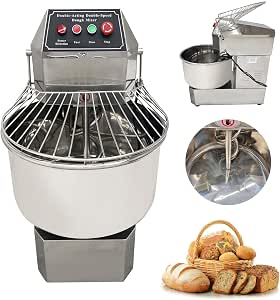
The BREVELTION 50Qt is the capacity leader in this group, aimed at bakeries, pizzerias, and institutional kitchens that need to work through large dough batches in fewer cycles. Its 2200 W motor drives a dual-action system in which the bowl rotates as the spiral hook kneads, a setup focused on dough development rather than the broader small-batch versatility of the KitchenAid Commercial 8-Quart. Two speeds keep operation straightforward, with a safety cover that shuts the machine off when opened. That scale brings real compromises: at roughly 30 inches wide and deep, it demands a dedicated footprint, and two speeds offer less adjustment for recipes that need gradual mixing changes. I would place it above the smaller mixers for bulk dough throughput, but not for kitchens needing a compact, all-purpose station.
Pros:- 50-quart bowl supports substantially larger batches than the 30-quart EKway
- Dual-action bowl rotation and spiral hook are designed for dough kneading
- 2200 W motor is specified for high-volume mixing
- Safety cover includes an automatic shut-off
Cons:- Large footprint makes it a poor fit for compact kitchens
- Two speeds provide limited control compared with the ten-speed KitchenAid
- 110 V specification may not suit kitchens with different electrical service
Best for: High-volume bakeries, pizzerias, and institutional kitchens with a dedicated mixing area and recurring large dough batches.
Not ideal for: Small cafes or kitchens with tight aisles, limited storage, or recipes that benefit from more than two speed choices.
- Capacity:50 quarts
- Power:2200 W
- Voltage:110 V
- Speed settings:2 (dual speed)
- Mixing mechanism:Dual-action bowl rotation and spiral kneading hook
- Material:304 stainless steel
- Safety feature:Safety cover with auto shut-off
- Dimensions:30.3″ D × 30.3″ W × 35.4″ H
Our verdict“Pick the BREVELTION when batch capacity and dedicated dough production matter more than a compact footprint or fine speed control.”
EKway 30qt Commercial Food Mixer with Timing Function, 1250W 3-Speed Adjustable Heavy-Duty Electric Stand Mixer
The EKway 30qt adds a useful production aid to the large-batch format: its timer can run for up to 60 minutes, so an operator can set a mixing interval without relying on constant manual timing. The 30-quart bowl and stated capacity of up to 13.2 lb (6 kg) of dough suit substantial bakery prep, while three speeds and included hook, beater, and whisk cover more than dough alone. Compared with the LEEVOT 30QT, the EKway provides a specified timer and stated weight, giving buyers clearer operating details. Its 146-pound weight makes relocation difficult, and the speed controls require a stop before changing settings, which can interrupt a workflow. I would favor it for repeatable scheduled batches, not for teams that need to move the mixer between stations.
Pros:- 60-minute timer supports repeatable mixing intervals
- 30-quart bowl is specified for up to 13.2 lb (6 kg) of dough
- Three speeds and three attachments cover dough, batters, and whisking
- 304 stainless steel bowl is designed for food-contact use and easy cleaning
Cons:- 146-pound weight makes repositioning difficult
- Mixer must be stopped before changing speeds
- Smaller capacity than the 50-quart BREVELTION for the largest production runs
Best for: Production bakeries and commercial kitchens that run repeatable large batches and value a programmable mixing interval.
Not ideal for: Kitchens that frequently rearrange equipment or need to change speeds while mixing; it weighs 146 pounds and requires a manual stop before speed changes.
- Model:SZM-30
- Capacity:30 quarts; up to 13.22 lb (6 kg) of dough
- Power:1250 W
- Voltage:110 V
- Speeds:3
- Timer:Up to 60 minutes
- Bowl material:Food-grade 304 stainless steel
- Weight:146 lb
- Included accessories:Dough hook, flat beater, wire whisk
Our verdict“Choose the EKway for a fixed production station where timed 30-quart batches matter more than easy mobility or uninterrupted speed changes.”
LEEVOT Commercial 30QT Heavy Duty Stand Food Mixer, 3-Speed Electric Dough Mixer with Stainless Steel Bowl
The LEEVOT 30QT targets commercial kitchens that want a large bowl, a 1250 W motor, and three speeds without relying on a timer as a central selling point. Its stated capacity of up to 22 lb of dough per batch is higher than the EKway’s listed 13.2 lb figure, though capacity claims should be checked against the dough and recipe being mixed. The safety shield and automatic shutdown add operator protection, while multiple attachments broaden its use beyond kneading. Compared with the EKway 30qt, the LEEVOT reports a larger dough-load figure but does not provide a listed weight or timer, leaving less detail for planning a fixed production process. Its 120 V supply and sizable body also make it a less flexible choice for some facilities.
Pros:- 30-quart bowl is stated to handle up to 22 lb of dough per batch
- 1250 W motor and three speeds support varied mixing tasks
- Multiple attachments extend use beyond dough prep
- Safety shield and automatic shutdown are listed
Cons:- Dimensions indicate a substantial footprint, and the product weight is not specified
- 120 V, 60 Hz supply may not fit facilities using different electrical service
- No timer is listed, unlike the EKway 30qt
Best for: Bakeries, pizzerias, and restaurants seeking a 30-quart mixer for substantial batches and a basic three-speed workflow.
Not ideal for: Facilities needing a documented timer, known machine weight, or electrical compatibility beyond the listed 120 V supply.
- Capacity:30 quarts
- Stated dough capacity:Up to 22 lb per batch
- Motor power:1250 W
- Number of speeds:3
- Voltage:120 V
- Frequency:60 Hz
- Materials:Stainless steel, cast iron
- Dimensions:22″ D × 17.7″ W × 31.5″ H
Our verdict“Consider the LEEVOT for a fixed commercial station that prioritizes its stated dough capacity, but choose the EKway if timer details are central to your workflow.”
Winco 20 L Commercial-Grade Planetary Mixer with Hub
The Winco 20 L is a mid-capacity planetary mixer for bakeries, delis, and cafes that want sturdy daily-use construction and a path to hub-compatible attachments. Its gear-driven, high-torque transmission has three speeds, and the package includes a spiral dough hook, flat beater, and whip—useful when a kitchen alternates between dough, batter, and frosting. The industry-standard #12 hub adds flexibility beyond the supplied tools. Compared with the KitchenAid Commercial 8-Quart, the Winco offers a larger bowl and cast-iron construction, but it is also much heavier at 246.9 pounds. It cannot match the 30-quart EKway or 50-quart BREVELTION for batch volume, so its strongest case is a fixed station needing varied prep rather than maximum dough throughput.
Pros:- 20-liter stainless steel bowl offers more capacity than the 8-quart KitchenAid
- Cast-iron construction and gear-driven transmission are specified for commercial use
- Includes spiral dough hook, flat beater, and whip
- Industry-standard #12 attachment hub expands accessory options
Cons:- At 246.9 pounds, it is difficult to relocate
- 20-liter capacity falls short of the 30-quart and 50-quart mixers for large dough runs
- Three speeds offer less adjustment than the ten-speed KitchenAid
Best for: Established bakeries, delis, and cafes that need a durable planetary mixer for regular mixed prep and want #12 hub compatibility.
Not ideal for: Small kitchens that need to move equipment often, or high-volume dough operations that would benefit from a 30- or 50-quart bowl.
- Capacity:20 liters
- Bowl material:304 stainless steel
- Construction:Die-cast iron
- Number of speeds:3
- Transmission:Gear-driven, high-torque
- Attachment hub:Industry-standard #12
- Included attachments:Whip, flat beater, spiral dough hook
- Safety features:Safety guard and interlocking mechanism
- Weight:246.9 lb
Our verdict“Choose the Winco for a stationary bakery prep line that needs durable planetary mixing and hub compatibility, not the largest possible dough batches.”

How We Picked
I compared the 15 listed mixers through the lens of commercial baking and dough preparation, focusing on stated capacity, motor information, speed and timer controls, mixer design, and the range of workloads each format appears suited to. I gave weight to whether a model could plausibly match a buyer’s batch size and production rhythm, rather than ranking by bowl size or wattage alone. Where product names or listed specifications did not establish details such as duty cycle, minimum batch size, or service support, I treated those as points buyers should verify rather than assuming an advantage.
The ranking favors useful balance: the Waring Luna 20-quart sits ahead of larger machines for its mid-sized capacity and digital timer, while the BREVELTION’s 50-quart scale makes it a specialist pick rather than a universal winner. I also separated dedicated dough-oriented designs from planetary mixers, since these serve different production needs. Similar 30-quart listings are grouped by their stated features and should not be treated as interchangeable without checking manufacturer documentation, electrical requirements, attachments, bowl guards, and warranty terms.
Factors to Consider When Choosing High Ticket Commercial Stand Mixer For Baking And Dough Prep
A commercial mixer is a production tool, so I’d choose around the work it must repeat every day—not the biggest number on a product page. These factors help clarify whether a high-capacity planetary mixer, a smaller commercial unit, or a dough-focused spiral design fits your operation.
Match Bowl Capacity to Your Usual Batch
Start with the dough or batter quantity you make most often, then check the manufacturer’s rated capacity for that specific recipe type. A bowl’s nominal volume is not the same as its workable dough load, and stiff dough can place a different burden on the mixer than airy batters. Buying far beyond your usual batch size can leave you mixing below the machine’s effective range, while an undersized bowl forces extra cycles during busy production. Ask for minimum and maximum batch guidance, especially if your menu ranges from small test recipes to full production runs. This matters across this lineup, where 8-quart models and 50-quart machines represent very different operating scales.
Choose Planetary or Spiral for the Work
Planetary mixers use an attachment that moves around the bowl, making them a flexible fit for dough, batters, creams, and other preparation tasks when the right attachments are supplied. Spiral mixers are built around dough mixing and may be a better match for businesses that repeatedly produce bread or pizza dough. Neither format is automatically superior: a dough-focused machine can limit flexibility, while an all-purpose planetary unit may not match the workflow of a dedicated dough station. Consider your full menu and the amount of non-dough work before choosing. The Ooni Halo Pro’s spiral format is a notable contrast to the many planetary options listed here.
Treat Wattage and Speed Counts as Incomplete Evidence
Motor wattage and the number of speeds can help narrow a shortlist, but they do not tell the whole story about sustained performance with dense dough. Duty-cycle limits, transmission design, recommended batch loads, and the intended dough hydration all affect whether a mixer suits repeated commercial use. A three-speed machine may be entirely adequate for a defined production routine, while a long list of speed settings may be more useful when recipes require careful control. Request written capacity guidance for your heaviest dough instead of comparing wattage in isolation. This is especially useful when several 30-quart listings share similar headline power and speed claims.
Check Power, Placement, and Workflow Before Ordering
A large mixer needs more than floor or counter space: its bowl and attachments need room to load, remove, and clean, and the operator needs safe access during repeated batches. Confirm voltage, plug type, circuit needs, and any installation requirements against the exact model; the BREVELTION listing, for example, specifies 110V, but buyers should still verify the complete electrical details. Measure access routes and the location where the mixer will be used, not just the machine’s footprint. Also consider whether a timer, bowl guard, or lifting arrangement will reduce interruptions and make routine work easier. A machine that fits the recipe but disrupts the room’s workflow can slow production rather than improve it.
Verify Attachments, Cleaning, and Service Support
Included attachments determine whether a mixer can handle your actual menu, so confirm the supplied hook, beater, whip, and any specialty tools rather than assuming they come standard. Check how the bowl and guard are removed, which surfaces are accessible for cleaning, and whether replacement parts are available through a dependable channel. For a commercial purchase, ask about warranty coverage, repair access, and expected support response before committing; these details can matter more than a small difference in listed power. Hub-equipped models such as the Winco 20 L may offer added versatility, but only if compatible accessories are available and useful to your operation. Compare the complete operating package, not just the base machine.
Frequently Asked Questions
Is a 30-quart mixer automatically better for bread dough than an 8- or 20-quart model?
No. Bowl volume indicates space, not the maximum safe dough load or how well the mixer handles a stiff recipe. A 30-quart model may help a bakery that regularly produces larger batches, but it can be an awkward fit for a small operation making frequent small runs. Ask each manufacturer for recommended dough capacity by recipe type and minimum batch size. Choose the model that suits your normal production, with room for realistic peak demand.
Should I choose a spiral mixer or a planetary mixer for a bakery that makes mostly bread and pizza?
A spiral mixer deserves a close look when bread and pizza dough dominate production, since its design is centered on dough mixing. A planetary mixer is generally the more flexible direction when the same machine must also handle batters, creams, and varied preparation tasks. The Ooni Halo Pro is the lineup’s spiral-style option, while most of the other listed models are planetary mixers. Before deciding, compare the recipes you make most, batch sizes, and whether you have room and budget for a separate machine for other tasks.
Can I rely on a mixer’s wattage to know whether it can handle stiff dough?
Wattage alone cannot confirm that a mixer is suited to dense or repeated dough batches. Transmission design, duty cycle, rated dough capacity, and the recipe’s hydration all affect performance. The listed 30-quart mixers with 1250W may look similar on paper, but those figures do not establish that their construction, service support, or recommended workloads are the same. Ask for manufacturer guidance on your specific dough and production frequency before ordering.
What should I verify before buying one of the similarly specified 30-quart mixers?
Compare the exact model documentation for bowl and attachment materials, included tools, timer operation, speed controls, safety guard, and electrical requirements. Confirm rated capacity for both dough and lighter mixtures, plus the manufacturer’s guidance on continuous or repeated use. Check warranty terms, parts availability, and who will service the unit in your area. Similar names and headline specifications are not enough to establish that two listings offer the same machine or support.
When is it worth choosing the 50-quart BREVELTION over a smaller commercial mixer?
The BREVELTION is most relevant when your operation regularly needs large batches and has the space, electrical setup, and workflow to use a 50-quart machine. Its stated 2200W motor and dual-action, dual-speed description make it a high-capacity specialist in this lineup, but buyers should confirm its rated dough loads and duty guidance directly. A larger mixer can be wasteful if your normal production consists of small batches or if its footprint complicates cleaning and loading. Compare the cost of the full installation and service plan with the production time you expect to save.
Conclusion
For the broadest fit across commercial baking and dough prep, I’d choose the Waring Commercial Luna 20-quart as the best overall pick, thanks to its mid-sized capacity and digital timer. The best premium, high-volume option is the BREVELTION 50-quart for operations with genuinely large batch requirements and the space to support it. For a more accessible capacity tier, the VEVOR 15-quart is a best-value candidate to investigate, but I’d verify its duty guidance, included attachments, and support before purchase. Beginners should favor a manageable 8- to 10-quart commercial model, such as a KitchenAid Commercial 8-quart or Waring Luna 10-quart, when smaller batches and varied baking tasks matter more than throughput. For dough-first production, the Ooni Halo Pro is the specific-use choice; for larger planetary workflows, compare the 30-quart options by service, safety features, and verified capacity rather than by bowl size alone.