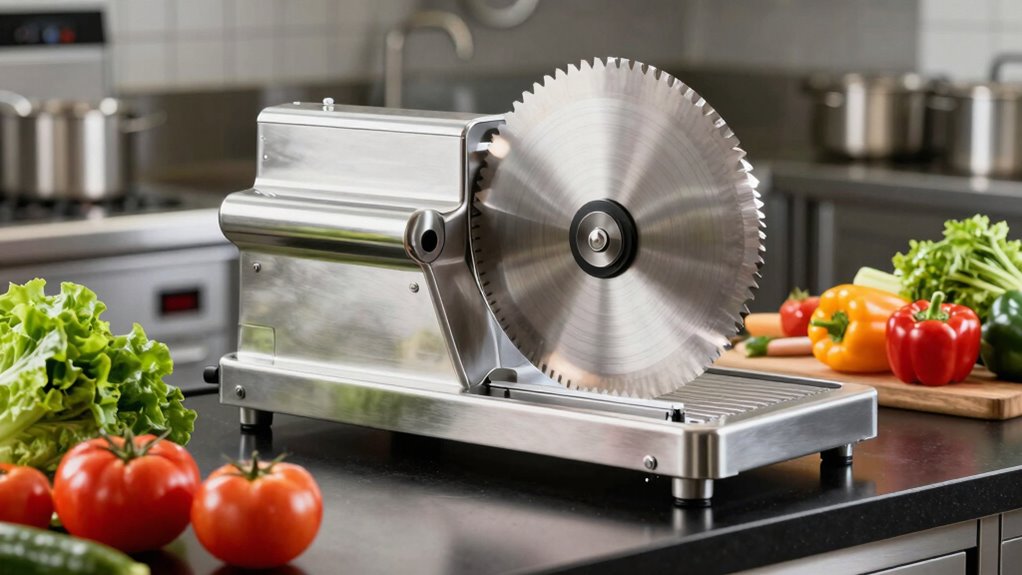

A high-ticket commercial food slicer should match your daily volume and the foods you cut, not just have the biggest blade or motor. My best overall pick is the KWS KitchenWare Station 10NS, which combines a high-torque motor with NSF and ETL certification for buyers who prioritize documented commercial suitability. The VEVOR 1100LB/H 750W cutter stands out for throughput, while the BESWOOD 10-inch slicer offers a distinctive chromium-plated blade and serving plate. The main tradeoffs are capacity versus footprint, power versus cleaning demands, and lower upfront complexity versus commercial credentials. Read on for the full breakdown and help choosing the right fit for your operation.

Get kitchen staples and gadgets delivered free with Prime
- Fast, free delivery on millions of items
- Prime Video, Amazon Music and more included
- Member-only deals all year
Key Takeaways
- The KWS 10NS leads on commercial credentials: its NSF and ETL certifications distinguish it from options whose listings focus mainly on blade size or motor power.
- The VEVOR 750W model is the throughput-focused choice: its stated 1100 lb/h capacity targets production needs that exceed what a typical deli counter slicer is meant to handle.
- A 12-inch blade is not automatically the better buy: the VEVOR 12-inch models trade a larger cutting area for more space and a potentially less convenient fit in compact prep areas.
- The two 400W-and-under VEVOR 12-inch and 10-inch models serve different workloads: compare blade diameter and your largest product before treating their power figures as a simple performance ranking.
- Home-friendly positioning can mean a different fit: FOHERE is explicitly marketed for home use, so buyers seeking equipment for continuous commercial shifts should verify duty-cycle and service details before choosing it.


| high ticket commercial food slicer | Weight | Dimensions | Blade size | Blade material |
|---|---|---|---|---|
| VEVOR Commercial Meat Slicer 1 | 24.9 pounds | 16.85 × 14.57 × 13.19 inches | 10 inches | — |
| VEVOR 12-Inch Commercial Meat | 46.3 pounds | 21.6 × 17.7 × 16.5 inches | — | Carbon steel |
| FOHERE 300W Commercial Electri | 38.6 pounds | 22.04 × 18.3 × 16.7 inches | 10 inches | Stainless steel |
| VEVOR 110V Commercial Meat Cut | 99 pounds | 22 × 13 × 26 inches | — | — |
| BESWOOD 10" Premium Chromium-P | 33 pounds | 20 × 17 × 14.75 inches | 10 inches | High-carbon chromium-plated steel |
| VEVOR Commercial Meat Slicer 1 | 45.4 pounds | 17.72 × 21.65 × 16.54 inches | 12 inches | Carbon steel |
| KWS KitchenWare Station 10NS C | — | — | 10 inches | Stainless steel |
More Details on Our Top Picks
VEVOR Commercial Meat Slicer 10″ Electric Food Frozen Deli Slicer 300W
The 10-inch blade and 300W motor make this VEVOR a practical choice for smaller operations that mainly portion frozen meat and want a slicer that is easier to place and move than the 12-inch VEVOR. Its thickness range reaches 12 mm, giving buyers useful control for deli-style portions, while the built-in sharpener can simplify routine blade upkeep. The plastic exterior keeps the listed weight to 24.9 pounds, a clear portability advantage over the 46.3-pound VEVOR 12-Inch Commercial Meat Slicer. That lighter build is also the tradeoff: it is less suited to buyers seeking a heavy, all-metal machine for sustained restaurant production. Its stated use centers on frozen meat and similar foods, so I would choose the BESWOOD 10-inch slicer instead for broader everyday food versatility.
Pros:- 300W motor is specified for quick slicing of frozen meat.
- Adjustable thickness from 0 to 12 mm supports varied portion sizes.
- At 24.9 pounds, it is lighter than the VEVOR 12-inch model.
- Built-in sharpener and detachable parts support blade care and cleanup.
Cons:- Plastic exterior is a less substantial choice than the aluminum alloy body of the VEVOR 12-inch model.
- The stated application focuses on frozen meat and similar foods rather than a wide range of ingredients.
- Noise level is not specified, leaving an operational detail unclear for open kitchens.
Best for: Small butcher counters and home kitchens that primarily slice frozen meat and need a lighter 10-inch machine.
Not ideal for: Busy delis seeking an all-metal build or buyers who need a slicer clearly suited to a broad range of foods.
- Power:300W
- Blade size:10 inches
- Blade and exterior materials:Stainless steel blade; plastic exterior
- Thickness adjustment:0–12 mm (0–0.5 in)
- Weight:24.9 pounds
- Dimensions:16.85 × 14.57 × 13.19 inches
- Operation mode:Semi-automatic
Our verdict“Choose this VEVOR for frozen-meat slicing in a smaller workspace where lower weight matters more than an all-metal build.”
VEVOR 12-Inch Commercial Meat Slicer 320W Electric Deli Food Cutter
For buyers who want a larger cutting surface and a more substantial chassis than the 10-inch VEVOR, this 12-inch slicer is the stronger fit. Its aluminum alloy construction and 46.3-pound weight offer a stable base, while the carbon steel blade and thickness adjustment up to 15 mm give it room for thicker cuts than the 10-inch VEVOR’s 12 mm limit. The built-in sharpener is useful for maintaining the blade without adding a separate sharpening tool. This is still a semi-automatic machine, so it calls for operator involvement rather than offering the listed automatic operation of the FOHERE. Its size and weight make frequent relocation inconvenient, and hand washing adds cleanup work. I’d favor it for a fixed deli station, not a cramped or highly mobile setup.
Pros:- 12-inch carbon steel blade provides a larger cutting area than the 10-inch VEVOR and BESWOOD models.
- Thickness adjusts up to 15 mm, exceeding the 12 mm range of the VEVOR 10-inch slicer.
- Aluminum alloy body and 46.3-pound weight support a planted worktop setup.
- Built-in sharpener helps with ongoing blade maintenance.
Cons:- At 46.3 pounds, it is awkward to move frequently.
- Hand-wash-only cleanup takes more effort than a design with simpler removable parts.
- Semi-automatic operation requires operator effort during slicing.
Best for: Delis and small restaurant kitchens that want a stable 12-inch slicer for varied cuts and can leave it in one place.
Not ideal for: Operators who need a lightweight machine, automatic operation, or a slicer that is quick to clean without hand washing.
- Blade diameter:12 inches
- Power:320W
- Speed:350–400 RPM
- Thickness adjustment:0–15 mm (0–0.6 in)
- Body material:Aluminum alloy
- Blade material:Carbon steel
- Dimensions:21.6 × 17.7 × 16.5 inches
- Weight:46.3 pounds
Our verdict“Pick this VEVOR for a fixed commercial station that benefits from a larger blade and thicker-cut adjustment.”
FOHERE 300W Commercial Electric Meat Slicer for Home
The FOHERE stands apart from the two VEVOR slicers by listing automatic operation, which may suit buyers who want less manual feeding effort during routine prep. Its 300W motor, 10-inch stainless steel blade, and large loading tray target home kitchens and light commercial use, with a stated ability to handle meat, cheese, and vegetables. The 38.6-pound weight makes it substantially heavier than the VEVOR 10-inch model, so its larger footprint and reduced portability are part of the exchange for a more substantial setup. Thickness tops out at 12 mm, below the VEVOR 12-inch model’s 15 mm range. I’d choose it over that heavier-duty VEVOR when automatic operation and a listed ETL certification matter more than thicker cuts or a bigger blade.
Pros:- Automatic operation distinguishes it from both semi-automatic VEVOR slicers.
- Stainless steel blade and 300W motor are suited to meat, cheese, and vegetables.
- Large loading tray can reduce repeated loading during prep.
- ETL Listed certification is specified in the product data.
Cons:- At 38.6 pounds, it is much heavier than the VEVOR 10-inch model.
- The 12 mm maximum thickness is less than the VEVOR 12-inch model’s 15 mm range.
- The product is positioned for home and light commercial use, limiting its fit for heavy production.
Best for: Home cooks and light-commercial operators preparing meat, cheese, and vegetables who prefer a slicer listed as automatic.
Not ideal for: High-volume kitchens needing thicker cuts, frequent relocation, or equipment described for sustained heavy commercial production.
- Motor power:300W
- Blade size:10 inches
- Blade material:Stainless steel
- Thickness adjustment:0–12 mm
- Dimensions:22.04 × 18.3 × 16.7 inches
- Weight:38.6 pounds
- Operation mode:Automatic
- Certification:ETL Listed
Our verdict“Choose the FOHERE when automatic operation and multi-food prep matter more than portability or thicker slicing.”
VEVOR 110V Commercial Meat Cutter Machine 1100LB/H Electric Meat Slicer 750W Stainless Steel
This machine occupies a different tier from the countertop-style slicers in this group: its stated 750W motor and capacity of up to 1,100 pounds per hour target production work, not occasional deli slicing. The food-grade stainless steel construction, detachable blade, and automatic operation are aimed at kitchen or supermarket workflows where throughput and cleaning access matter. Compared with the VEVOR 12-Inch Commercial Meat Slicer, this model is much heavier at 99 pounds and is defined by output capacity rather than a listed adjustable thickness range. That makes it a poor match for buyers seeking a flexible countertop slicer for thin portions or a machine they can move between stations. The emergency stop adds a useful safety control, but the supplied details do not fully specify cutting adjustments, so I would confirm those needs before choosing it.
Pros:- Stated capacity of up to 1,100 pounds per hour targets high-volume production.
- 750W motor exceeds the power listed for the other countertop-style models here.
- Food-grade stainless steel construction is suited to commercial food-processing environments.
- Detachable blade and emergency stop support maintenance access and operational safety.
Cons:- At 99 pounds, it is difficult to relocate without help.
- The provided specifications do not list an adjustable slice-thickness range.
- The available safety details are limited to the emergency stop and detachable blade.
Best for: Restaurants, supermarkets, and food-processing kitchens that need high stated throughput and have a dedicated, stable installation area.
Not ideal for: Small delis, home users, or operators who need a portable slicer with a clearly specified adjustable thickness range.
- Voltage:110V
- Power:750W
- Cutting capacity:Up to 1,100 pounds per hour
- Material:Food-grade stainless steel
- Blade thickness:3 mm
- Dimensions:22 × 13 × 26 inches
- Weight:99 pounds
- Operation mode:Automatic
Our verdict“Choose this VEVOR for a fixed commercial production area where stated throughput matters more than portability or detailed thickness control.”
BESWOOD 10″ Premium Chromium-Plated Steel Blade Electric Deli Meat & Cheese Food Slicer with Serving Plate, 240W, Classic Silver
The BESWOOD is the most clearly positioned for multi-food deli prep: its product details name meat, cheese, vegetables, ham, and fruit, while its chromium-plated steel blade is described as corrosion-resistant. That makes it a broader everyday option than the frozen-meat-focused VEVOR 10-inch slicer. The included removable serving plate and cleaning brush support cleanup, and the double illuminated switch adds a visible power-control feature. At 240W, it has less listed motor power than the 300W VEVOR and FOHERE models, and the data does not state a thickness-adjustment range. That missing detail matters for buyers who need precise slice settings. At 33 pounds, it is also heavier than the lighter VEVOR, though still below the 46.3-pound VEVOR 12-inch model.
Pros:- Chromium-plated steel blade is described as corrosion-resistant and designed to retain sharpness.
- Product use includes meat, cheese, vegetables, ham, and fruit.
- Removable serving plate and included cleaning brush support cleanup.
- Double illuminated ON/OFF switch provides a clearly visible power control.
Cons:- At 240W, it has less listed power than the 300W VEVOR 10-inch and FOHERE models.
- No adjustable thickness range is provided in the product data.
- Its 33-pound weight makes it less convenient to move than the VEVOR 10-inch slicer.
Best for: Deli counters and home kitchens that slice a mix of meats, cheese, vegetables, and fruit and value a corrosion-resistant blade.
Not ideal for: High-output operators who need a stated thickness range, higher listed motor power, or a lightweight machine for frequent moves.
- Power:240W
- Blade size:10 inches
- Blade material:High-carbon chromium-plated steel
- Body material:Aluminum
- Switch:Double illuminated ON/OFF switch, 24V
- Dimensions:20 × 17 × 14.75 inches
- Weight:33 pounds
- Included components:Food slicer machine, instruction manual, cleaning brush, food machine oil, seal ring oil, serving plate
Our verdict“Pick the BESWOOD for varied deli and kitchen prep when blade corrosion resistance matters more than a stated thickness range or higher motor power.”
VEVOR Commercial Meat Slicer 12″ Electric Food Frozen Deli Slicers 400W
The 12-inch carbon steel blade and 400W motor give this VEVOR more room and power than the KWS KitchenWare Station 10NS, making it a better fit for larger cuts and repeated slicing across meat, vegetables, and fruit. Its 0–15 mm adjustment range also suits jobs that call for thicker portions, not only deli-thin slices. The aluminum body and removable parts support regular cleaning, though hand washing adds work compared with a setup designed for quicker cleanup. At 45.4 pounds, it is a substantial machine rather than one to move in and out of storage casually. Semi-automatic operation also means it does not offer the workflow of a higher-throughput powered cutter such as the VEVOR 750W meat cutter elsewhere in this roundup. I’d choose it for capacity and versatility, not for compactness or minimal handling.
Pros:- 12-inch blade accommodates larger cuts than the KWS 10NS’s 10-inch blade.
- 400W motor provides more power than the 320W KWS 10NS.
- Thickness adjusts from 0 to 15 mm for thin slices and thicker portions.
- Removable parts support cleaning, and the aluminum body is built for regular use.
Cons:- At 45.4 pounds, it is cumbersome to relocate or store between uses.
- Hand-wash-only cleaning takes more effort than a quicker-cleaning setup.
- Semi-automatic operation may limit pace for high-volume service.
Best for: Small commercial kitchens, delis, or serious home food preparers who need a 12-inch blade and broad thickness adjustment for varied ingredients.
Not ideal for: Buyers with limited counter or storage space, or operators who need faster cleanup and a more automated, high-throughput workflow.
- Motor power:400W
- Blade size:12 inches
- Blade material:Carbon steel
- Thickness adjustment:0–15 mm
- Body material:Aluminum
- Weight:45.4 pounds
- Dimensions:17.72 × 21.65 × 16.54 inches
- Color:Silver
Our verdict“Choose this VEVOR if blade capacity and thicker-cut versatility matter more than easy portability or a fully automated workflow.”
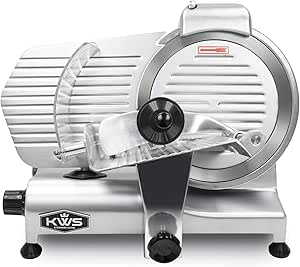
KWS KitchenWare Station 10NS Commercial 10-Inch Electric Meat Slicer, 320W, Stainless Steel Blade, High-Torque Motor, NSF & ETL Certified
The KWS 10NS is the more measured choice for operators who value NSF and ETL certifications and a stainless steel blade over the larger cutting area of the VEVOR 12-inch, 400W slicer. Its 320W high-torque motor is intended for continuous slicing, while the adjustable dial handles meat, cheese, and frozen foods. A 10-inch blade and 5.5-inch maximum product height place practical limits on larger cuts, but make this a more focused option for light-commercial stations and hunting or home processing. Removable components help with cleaning, and the included sharpener and hand guard add useful support. For ultra-thin slices, the product recommends partially freezing meat; bread slicing also requires an additional attachment. Compared with the VEVOR, this KWS trades blade size and power for stated third-party certifications.
Pros:- NSF and ETL certifications suit buyers checking equipment credentials for a work setting.
- 320W high-torque motor is designed for continuous slicing.
- Stainless steel blade resists rust and pitting.
- Includes a sharpener and hand guard, with removable parts for cleaning.
Cons:- 10-inch blade and 5.5-inch product-height limit are less accommodating than the VEVOR 12-inch model.
- Partially freezing meat may be needed for ultra-thin slices.
- Bread slicing requires an additional attachment, and the unit may be excessive for occasional home use.
Best for: Delis, light-commercial kitchens, and hunters who want NSF- and ETL-certified equipment for recurring meat and cheese slicing.
Not ideal for: High-volume operations needing a larger blade, or buyers who want to slice bread without purchasing an additional attachment.
- Motor power:320W
- Blade size:10 inches
- Blade material:Stainless steel
- Maximum product height:5.5 inches
- Tray dimensions:7 × 7.5 inches
- Certifications:NSF, ETL
- Model number:SSB10
- Included components:Belt and stone, hand guard, sharpener, slicer, user manual
Our verdict“Pick the KWS 10NS for certified light-commercial use and a stainless steel blade, but choose the larger VEVOR if your work demands more cutting capacity.”

How We Picked
I compared the seven listed slicers on the factors that affect real purchasing decisions: motor and stated throughput, blade diameter, commercial credentials, likely fit with the buyer’s workload, and practical ownership tradeoffs such as cleaning and counter space. I gave extra weight to clear evidence of commercial suitability, since the target buyer is considering a high-ticket machine rather than an occasional-use kitchen tool. A larger blade or higher wattage matters only when it solves a defined workload problem.
The ranking favors options with a clearer match to demanding commercial use, then separates models by capacity, size, and intended setting. The KWS leads for its stated high-torque motor and NSF and ETL certification; the VEVOR 750W model follows for its stated high throughput. Larger 12-inch slicers rank well for jobs that need a wider cutting area, while the 10-inch and home-oriented options suit more limited workloads. Product specifications alone do not establish duty cycle, warranty support, or cleaning ease, so I treat those as questions buyers should confirm before purchase.
| high ticket commercial food slicer | Blade material |
|---|---|
| VEVOR Commercial Meat Slicer 1 | — |
| VEVOR 12-Inch Commercial Meat | Carbon steel |
| FOHERE 300W Commercial Electri | Stainless steel |
| VEVOR 110V Commercial Meat Cut | — |
| BESWOOD 10" Premium Chromium-P | High-carbon chromium-plated steel |
| VEVOR Commercial Meat Slicer 1 | Carbon steel |
| KWS KitchenWare Station 10NS C | Stainless steel |
Factors to Consider When Choosing High Ticket Commercial Food Slicer
Choosing a commercial slicer is less about finding the biggest specification and more about matching equipment to your menu, workflow, and service pace. I would settle the following questions before comparing individual models, since they can rule out an unsuitable machine early.
Match Capacity to Your Peak Hour, Not Your Average Day
Estimate the amount of slicing needed during your busiest service window, then add a reasonable buffer for staffing changes and menu growth. A machine with a stated high throughput can help when volume is the bottleneck, but a headline capacity figure may not reflect your food type, slice thickness, operator pace, or breaks for cleaning. Ask the seller how capacity is defined and whether the machine is rated for continuous operation. Buying for an occasional rush can leave you with unnecessary bulk and maintenance needs; buying only for average volume can create a queue when orders cluster. Peak demand and duty cycle are more useful buying inputs than wattage alone.
Choose Blade Diameter Around Your Largest Regular Product
Blade size affects the usable cutting area and the dimensions of products you can handle, but it does not describe the whole machine. Measure the widest cheese, roast, or other item you slice, and check the carriage and product clearance as well as the blade diameter. A 12-inch blade may suit larger cuts, yet it can demand more counter room and may be more machine than a narrow-menu operation needs. A smaller blade can make more sense when products are modest in size and work surfaces are limited. Avoid paying for extra diameter without confirming that it changes what you can actually process.
Check Certification and Electrical Fit Before Ordering
Commercial buyers should confirm which certifications apply to the exact model and whether local health, building, or workplace rules require them. A listing that names NSF or ETL certification gives more concrete information than a general claim that a machine is commercial grade, but verify the certification scope and model number with the seller. Also check voltage, plug type, circuit requirements, and the available outlet near the intended station. An otherwise suitable slicer can create costly installation problems if the electrical setup does not match. Certification and site compatibility are purchase gates, not details to sort out after delivery.
Plan for Cleaning, Sharpening, and Safe Operation
Daily ownership includes more than wiping the visible surfaces: food-contact areas, blade access, guards, and carriage components all affect cleaning time and safe handling. Before buying, request the manufacturer’s cleaning instructions and confirm which parts can be removed, how they reattach, and whether replacement blades or sharpening support are available. A design that takes longer to clean can slow closing tasks or encourage rushed sanitation. Train staff on safe loading, use of guards, and lockout or unplugging procedures during cleaning. Maintenance access and staff training can matter as much as cutting speed over the life of the machine.
Compare Total Ownership, Not Just the Purchase Specification
For a high-ticket purchase, ask about warranty coverage, parts availability, service response, and who handles repairs in your area. Confirm whether the warranty distinguishes commercial use from residential use; a product marketed for home use may have terms that do not fit a busy kitchen. Include likely costs for sharpening, replacement parts, installation, and downtime in your comparison. Paying more can make sense when the machine’s documented suitability and support reduce operational risk, but a premium feature is poor value if your workflow will not use it. Serviceability and warranty terms help distinguish a genuine long-term investment from a specification-led purchase.
Frequently Asked Questions
Is a slicer marketed for home use suitable for a busy commercial kitchen?
Not automatically. A home-use label does not tell you whether the machine can handle your shift length, daily volume, or cleaning routine. Ask the manufacturer to confirm the duty cycle and whether the warranty covers commercial operation. Also check certification requirements and local rules for your workplace. If the seller cannot clarify those points, I would favor a model with clearer commercial documentation.
Should I choose the VEVOR 750W model because it lists 1100 lb/h capacity?
That stated throughput makes the model relevant to buyers with substantial processing demands, but it should not be your only selection test. Ask how the capacity figure was measured and whether it applies to the foods, thicknesses, and operating pattern you use. Confirm that the machine’s footprint, electrical requirements, and cleaning routine suit your station. If your operation slices modest quantities in short service windows, a high capacity rating may not repay the added demands. Match the claim to your actual workflow before making the call.
When is a 12-inch slicer worth the extra space over a 10-inch model?
A larger blade is most useful when the size or shape of your regular products limits what a smaller slicer can handle. Measure your largest items and confirm carriage clearance; blade diameter alone does not guarantee a fit. Then compare the machine’s full footprint with available counter and storage space. If your products fit comfortably on a 10-inch machine, the larger model may add bulk without improving service. A 12-inch unit makes more sense when it removes a real product-size bottleneck.
How much should NSF or ETL certification influence my choice?
Certification can be a deciding factor when local rules, inspectors, or procurement policies require documented compliance. The KWS 10NS listing names both NSF and ETL certification, which gives buyers a concrete point to verify against the exact model and their jurisdiction. Certification does not by itself establish throughput, ease of cleaning, or repair support. Check the certification records and ask local authorities or your equipment adviser what your facility needs. Treat it as one part of suitability, alongside capacity and service terms.
What should I confirm about warranty and parts before buying a high-ticket slicer?
Get the warranty terms in writing, including coverage length, labor, shipping, and any exclusions for commercial use. Ask whether the manufacturer or seller can supply blades and other wear parts, and how repairs are handled in your area. Clarify whether service requires shipping the full unit away, since downtime may matter more than the repair cost during a busy season. Compare support between models rather than assuming similar-looking machines have similar parts access. These checks can prevent a capable slicer from becoming difficult to keep in service.
Conclusion
For most commercial buyers, I would start with the KWS KitchenWare Station 10NS as the best overall, especially when certification and a high-torque motor matter. The VEVOR 1100LB/H 750W is my best pick for high-throughput needs, while the BESWOOD is the best premium-style option for buyers who value its chromium-plated blade and serving plate and can verify that the rest of its specifications suit their workload. For a value-focused purchase, compare the VEVOR 10-inch and 12-inch models against your product sizes and confirm support and operating requirements; the lower-priced assumption should not replace that check. Beginners should favor a manageable footprint and clear cleaning instructions, making the 10-inch options easier to evaluate than a large production machine. Choose a 12-inch VEVOR when larger products justify the space, and treat the FOHERE as a candidate for lighter-duty settings only after confirming commercial duty-cycle and warranty coverage.
Evergreen bestsellers Picks

De’Longhi La Specialista Touch Semi-Automatic Espresso Machine with Grinder

Dyson Cyclone V10 Origin Cordless Vacuum
KitchenAid Artisan 5-Quart Tilt-Head Stand Mixer, White
As an affiliate, we earn on qualifying purchases.